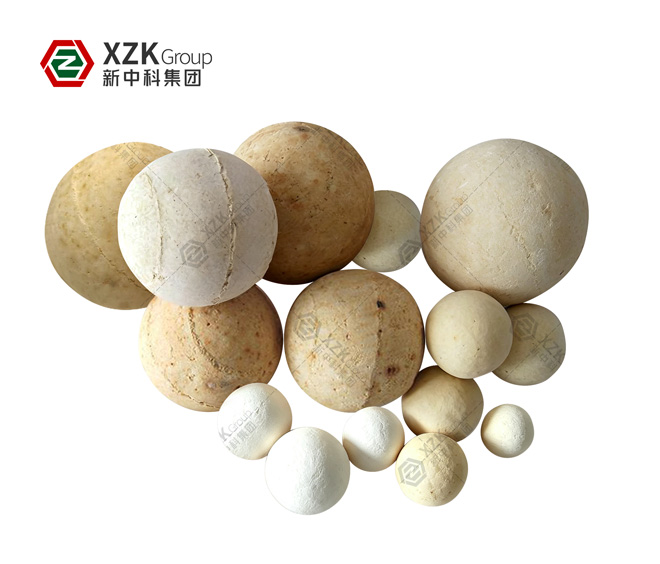
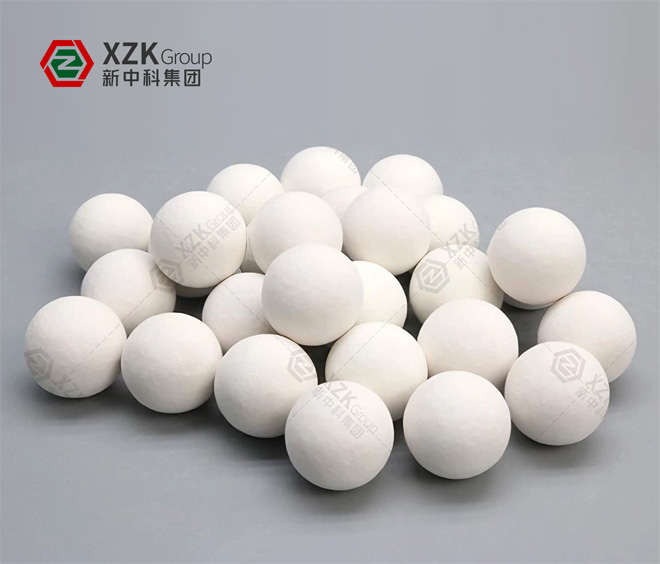
Corundum refractory balls are spherical heat-exchange media for regenerator packing, where the bed must absorb and release heat cycle after cycle without spalling, sagging or blocking the gas path. Made from the same corundum raw materials as our dense corundum bricks, they bring high refractoriness and abrasion resistance to a shape designed for gas flow.
XZK Group supplies corundum refractory balls from our Xinmi plant in Henan as a complete regenerator packing or as a replacement charge for existing checkerwork, sized to the void fraction and pressure drop of the chamber they fill.
What Is a Corundum Refractory Ball?
A corundum refractory ball is a high-alumina sphere formed by pressing or rolling corundum aggregate and alumina powder and then sintering the shape to develop the corundum bond. The body is dense, hard and chemically inert, with corundum as the dominant crystalline phase and no exudable glassy phase. Because it is a sphere, the packing has no flat faces and no mortar joints, so it contains none of the joint planes that open under thermal cycling in a stacked checker wall.
Balls are produced to a controlled diameter band, screened for size and roundness, and fired in tunnel or shuttle kilns. Dimensional consistency matters as much as chemistry here: an out-of-tolerance batch changes the void fraction of the bed and with it the pressure drop and the heat-transfer behaviour of the whole regenerator, so size control is treated as a quality parameter and not a packaging detail.
Random packing of spheres creates a large, evenly distributed heat-exchange surface with a high void fraction. Gas flows around the balls instead of channelling through straight vertical flues, which lowers pressure drop and removes the dead zones where sulphate condensate collects and sets. Because each sphere can settle individually, the bed absorbs thermal expansion without accumulating the compressive load that cracks stacked checker brick. A corundum ball also resists the abrasive batch dust carry-over that rounds off and eventually crushes softer fireclay packings.
Key Properties
- Corundum-dominant body sintered from the same high-purity raw materials as our dense corundum bricks, giving high refractoriness and chemical inertness in the hottest regenerator courses.
- High void fraction with random packing for a lower pressure drop and a more uniform gas distribution than straight-flue checkerwork of the same volume.
- No mortar joints and no flat faces, so the packing has no joint planes to open, spall or leak under repeated reversals.
- Abrasion resistance that holds the shape of the ball against batch dust carry-over, the mechanism that erodes and crushes softer packings ahead of schedule.
- Resistance to alkali vapour and sulphate condensate, the chemistry that softens, expands and blocks regenerator packings in the 800–1100°C condensation band.
- Rechargeable packing. Individual balls can be added or replaced to correct settling and restore the bed without rebuilding the entire regenerator chamber.








 WhatsApp
 WeChat
 WhatsApp
 WeChat