

Glass Furnace Refractories
One supplier from melting tank to regenerator — AZS side walls, zircon superstructure, corundum throats, mullite checkerwork and insulating back-up, specified zone by zone against your furnace data.
A glass furnace is not lined with one material. It is lined with a sequence of materials, each chosen for the temperature, the chemistry and the mechanical load of one zone. Get that sequence wrong in one place and the campaign life of the whole furnace is set by the weakest brick in it. This page sets out the full lining — what goes where, why, and how to choose between the grades.
XZK Group manufactures every refractory family a glass furnace needs, in our own plant in Xinmi, Henan: fused cast and sintered AZS, zircon and zircon mullite, corundum and chrome corundum, mullite and alumina-silica, insulating bricks, and the monolithic castables and ramming masses that seal the joints between them. Because they come from one factory, they are specified as one system rather than assembled from whatever different suppliers happen to stock.
What Determines a Glass Furnace Lining?
Four forces decide how long a lining lasts. Temperature sets the ceiling: the melting end runs at 1550–1600°C, the regenerator cycles between roughly 600°C and 1400°C, and the forehearth sits far lower but is far more sensitive to temperature variation. Chemistry decides what attacks the brick: soda and potash vapour from the batch, sulphate condensation in the regenerator, and the molten glass itself along the flux line. Mechanical load decides what deforms it: a regenerator carries hundreds of tonnes of checkerwork above the base courses, and creep — slow deformation over years — is what eventually closes joints and distorts the structure. Abrasion from batch and cullet decides how fast the surfaces wear.
No single brick resists all four. That is why a lining is zoned. AZS has the corrosion resistance for the glass contact area but is heavy and sensitive to thermal shock; mullite and alumina-silica carry load without creeping but cannot survive direct soda attack; zircon resists alkali vapour but has a lower refractoriness than corundum. The engineering task is not picking the best material — it is placing the right one in each zone.
Why buy the whole lining from one manufacturer?
Because zones interact. A joint between AZS paving and a ramming mass, or between a corundum throat and the zircon superstructure above it, fails at the interface more often than in the middle of a brick. When one factory supplies the bricks, the castables, the ramming masses and the mortar, the expansion coefficients, the dimensional tolerances and the joint design are all consistent — and there is one engineering team accountable if a zone underperforms.
Refractory Families for Glass Furnaces
Seven families cover the full lining. Each link below opens the dedicated page with grades, technical data and zoning guidance for that family.
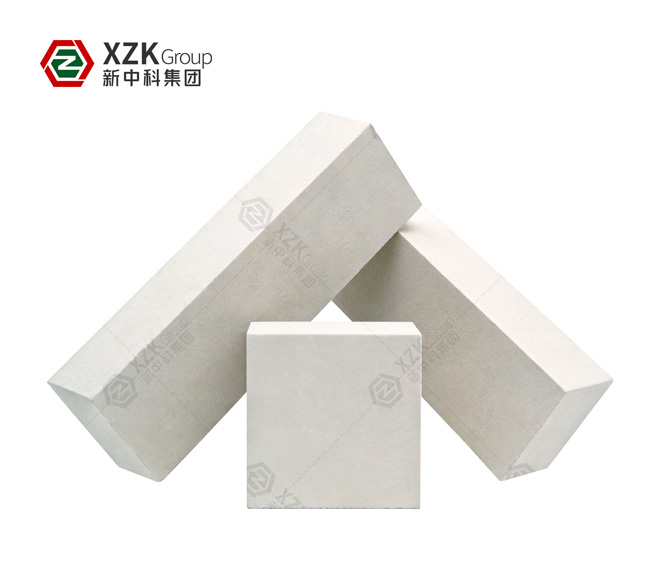
Glass contact zones
Fused Cast AZS
XZK-FAZS33 · FAZS36 · FAZS41
The workhorse of the glass contact area. Fused cast AZS is melted and cast rather than pressed, which produces a dense, interlocking zirconia-corundum structure that resists molten glass attack far better than any sintered brick.
Used for side walls, bottom paving and superstructure blocks in float, container and fibre glass furnaces. Zirconia content is selected against the severity of the zone: 33% for general side wall duty, 41% for the flux line and throat.
ZrO2 32.5–41% · Bulk density ≥ 3.75–3.95 g/cm3 · Glass phase exudation controlled

Glass contact, pressed
Sintered AZS
XZK-SAZS30 · RM-AZS
Sintered AZS covers the positions where a cast block is impractical: bottom paving, upper structure, and the rammed working surface that seals the tank floor.
It is more uniform in density than cast material and free of casting shrinkage cavities.
ZrO2 ≥ 30% · Porosity ≤ 17% · CCS ≥ 90 MPa · RUL ≥ 1620°C

Alkali resistant
Zircon and Zircon Mullite
XZK-ZR65-A · ZR65-B / ZM6 · ZM12 · ZM20 · ZM30
Zircon refractories are specified where alkali vapour does the damage. Above the glass line and in the regenerator, soda and potash vapour condenses into the brick and reacts with the silica phase; zircon is chemically resistant to that attack.
The mullite-bearing versions trade some zirconia content for better thermal shock resistance and lower cost — see the zircon bricks page for the zone-by-zone split.
ZrO2 ≥ 65% (zircon) / 6–30% (zircon mullite) · CCS ≥ 80–100 MPa
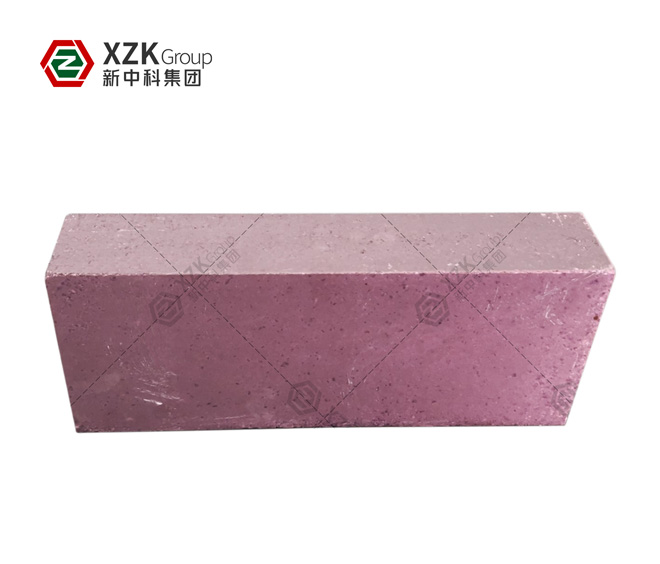
High wear and superstructure
Corundum and Chrome Corundum
XZK-CC10 · CC12 · CC15 · CC30 / Al2O3 90–99%
Corundum refractories have the highest refractoriness under load of any sintered brick we make, which is why they go where temperature and erosion are both extreme: the throat, the doghouse, burner blocks and the port area.
Chrome corundum adds Cr2O3 to the matrix, which raises erosion resistance against the soda-rich melt and against sulphate attack in the regenerator condensation zone. See corundum bricks for the full grade ladder.
Al2O3 up to 99% · Cr2O3 10–30% · CCS ≥ 100 MPa · RUL ≥ 1700°C

Structural
Mullite and Alumina-Silica
XZK-ML70 · CM80–90 · 3L-ML50 / SK32–SK40
The structural refractories. Mullite carries load without creeping and holds its dimensions over a multi-year campaign, which is what a regenerator base course, a rider arch and a forehearth cover block need.
Alumina-silica and high alumina grades cover the higher-alumina end of the same duty. See mullite bricks and the alumina-silica series.
Al2O3 50–90% · Creep at 1500°C ≤ 0.3% · RUL ≤ 1700°C

Regenerator internals
Regenerator Checker Bricks
Sillimanite SL57–SL65 · Andalusite AN65 · Barrel shapes
Checkerwork is a heat exchanger, not a wall. Its job is surface area and stable gas flow, so the bricks are shaped for stacking — standard rectangular, barrel and cylindrical — and specified for volume stability rather than peak refractoriness.
Sillimanite and andalusite grades mullitize in service and hold their dimensions over thousands of thermal cycles. See regenerator refractory bricks.
Al2O3 57–65% · Thermal shock ≥ 15–25 cycles · RUL 1560–1650°C

Back-up and sealing
Insulating and Monolithic
JM23–JM30 · LI140 / LC135 / Castables and ramming masses
Insulation controls shell temperature and heat loss; monolithics seal the joints, pave the tank bottom and line the shapes that cannot be bricked.
Neither is optional. A correctly specified hot face over a badly chosen back-up lining still loses its campaign life to shell overheating and joint erosion. See insulating bricks and monolithic refractories.
Bulk density 0.6–1.3 g/cm3 · Thermal conductivity ≤ 0.19–0.55 W/(m·K) at 350°C
Refractory Configuration by Furnace Type
The two sections below show where each material actually sits in the furnace. They are the same zoning logic our engineers apply when they review a lining: every labelled position carries a specific grade, and the grade changes as the duty changes. Open either furnace to see the full zone-by-zone configuration with working conditions, material list and case references.
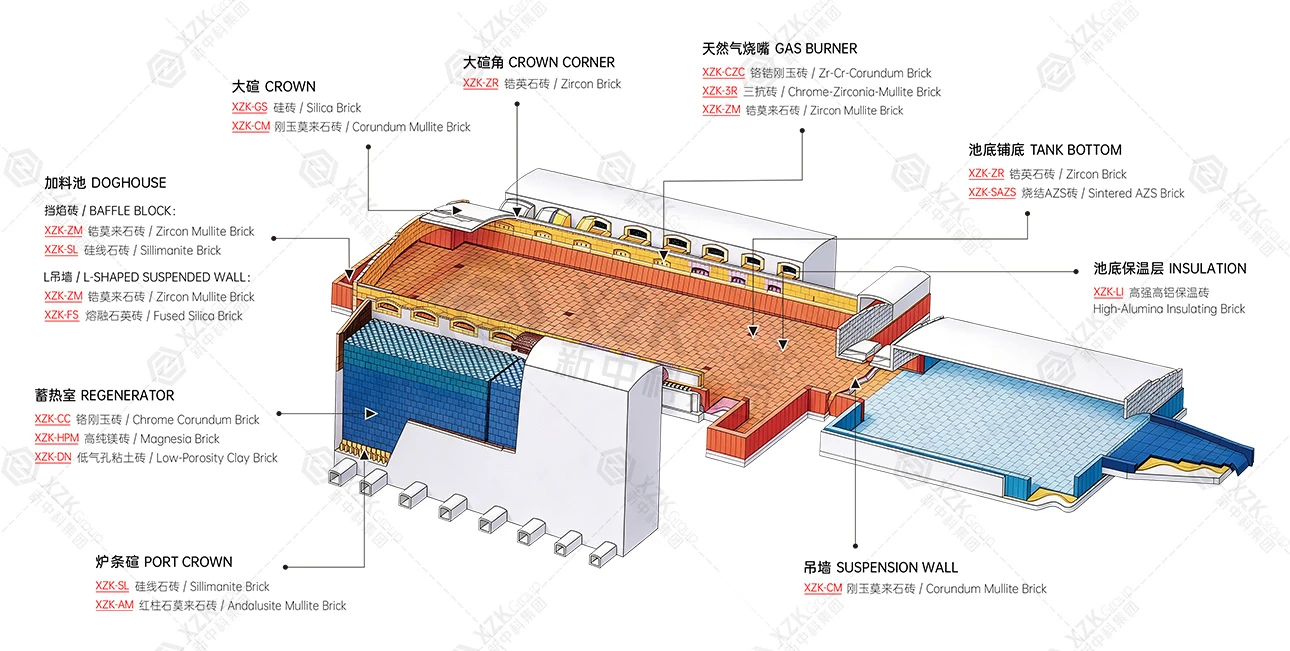
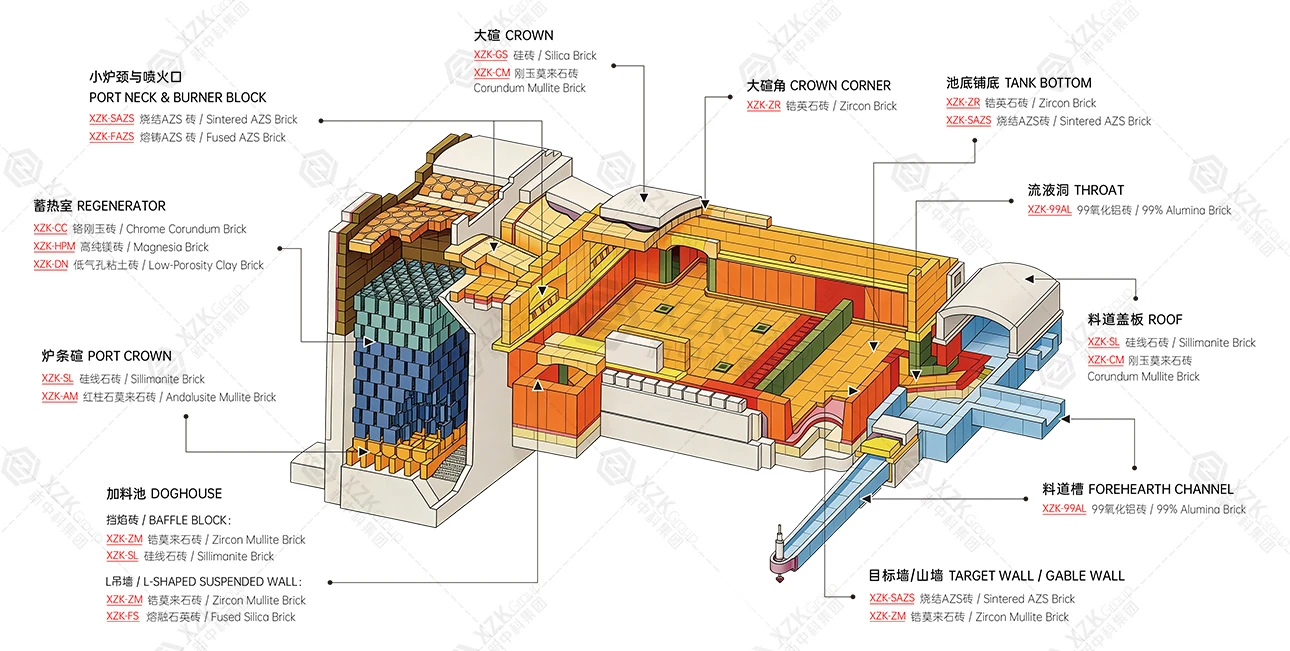
Typical Technical Data by Family
The tables below are the design window for each family, not a substitute for the detailed datasheet of the grade you specify. Every value is verified batch by batch in our own laboratory, and every shipment leaves with a certificate of analysis.
Glass contact and high-wear refractories
| Property | Fused cast AZS (FAZS36) | Sintered AZS (SAZS30) | Zircon (ZR65-A) | Chrome corundum (CC12) |
|---|---|---|---|---|
| Al2O3 (%) | ≥ 48.0 | ≥ 48 | — | ≥ 80.0 |
| ZrO2 (%) | ≥ 36.0 | ≥ 30 | ≥ 65 | — |
| Cr2O3 (%) | — | — | — | ≥ 12.0 |
| Bulk density (g/cm3) | ≥ 3.80 | ≥ 3.2 | ≥ 3.80 | ≥ 3.25 |
| Apparent porosity (%) | — | ≤ 17 | ≤ 17 | ≤ 17 |
| Cold crushing strength (MPa) | — | ≥ 90 | ≥ 100 | ≥ 100 |
| Refractoriness under load (0.2 MPa, °C) | — | ≥ 1620 | ≥ 1680 | ≥ 1700 |
Fused cast AZS is characterised by glass phase exudation and blistering rather than by porosity, so those cells are shown as not applicable.
Structural and regenerator refractories
| Property | Mullite (ML70) | Corundum mullite (CM85) | Sillimanite (SL60-P) | Andalusite (AN65-P) |
|---|---|---|---|---|
| Al2O3 (%) | ≥ 70 | ≥ 85 | ≥ 60.0 | ≥ 65.0 |
| Bulk density (g/cm3) | ≥ 2.65 | ≥ 2.90 | ≥ 2.45 | ≥ 2.50 |
| Apparent porosity (%) | ≤ 17 | ≤ 17 | ≤ 18 | ≤ 17 |
| Cold crushing strength (MPa) | ≥ 80 | ≥ 90 | ≥ 70 | ≥ 70 |
| Refractoriness under load (0.2 MPa, °C) | ≥ 1700 | ≥ 1700 | ≥ 1580 | ≥ 1650 |
| Thermal shock (cycles) | ≥ 25 (1100°C water) | — | ≥ 20 (1100°C water) | ≥ 15 (1100°C water) |
Back-up insulation
| Property | JM23 | JM26 | JM28 | JM30 | High alumina LI140-1.0 | Clay LC135-1.3 |
|---|---|---|---|---|---|---|
| Al2O3 (%) | 42 | 45 | 54 | 72 | ≥ 48 | — |
| Bulk density (g/cm3) | 0.6 | 0.8 | 0.7 | 1.1 | ≤ 1.0 | ≤ 1.3 |
| Cold crushing strength (MPa) | ≥ 1.5 | ≥ 2.3 | ≥ 2.0 | ≥ 3.5 | ≥ 3.0 | ≥ 8.0 |
| Thermal conductivity, 350°C (W/(m·K)) | ≤ 0.19 | ≤ 0.24 | ≤ 0.21 | ≤ 0.43 | ≤ 0.40 | ≤ 0.55 |
Insulating bricks are selected by cold-face temperature target, not by hot-face temperature alone. Send the lining build-up and we will size density and thickness.
What Goes Where: Refractories by Furnace Zone
The zones below follow the gas path and the glass path through a regenerative furnace. The same logic applies to float, container, tableware and fibre glass furnaces — what changes is the operating data you feed in, not the principle.
Melting tank side walls and flux line
The flux line is the single most aggressive point in the furnace: molten glass, batch dust and alkali vapour attack the brick at the same time, with the glass surface moving up and down as the level is controlled.
Fused cast AZS with high zirconia content (XZK-FAZS41 at the line, FAZS36 below it) is the standard answer. Joints are tight and staggered so glass cannot penetrate.
Typical grades: FAZS41 (flux line) · FAZS36 (below line)
Melting tank bottom and paving
The tank floor carries the glass head and, at the end of the campaign, whatever metal and dense batch has settled out of the melt. Upward drilling — where bubbles in the joints migrate upward and carry molten glass with them — is the failure mode to design against.
Sintered AZS paving over a rammed sealing layer is the usual build, with the AZS ramming mass closing the gaps between pavers.
Typical grades: SAZS30 paving · RM-AZS sealing layer
Superstructure, crown and breast walls
Above the glass line the attack switches from molten glass to alkali vapour and batch carry-over. Thermal cycling is severe, so thermal shock resistance matters as much as refractoriness.
Zircon and zircon mullite handle the alkali load; corundum mullite covers the hottest sections. Crown back-up insulation is a separate decision — see lightweight silica and mullite insulating bricks.
Typical grades: ZR65 zircon · ZM20 / ZM30 zircon mullite · CM85 corundum mullite
Throat, doghouse and bubbler blocks
The throat accelerates the glass and exposes the brick to the highest velocity and the highest temperature in the furnace. Doghouse corners see the incoming batch at its most abrasive.
Chrome corundum is the standard material here — the Cr2O3 raises erosion resistance where corundum alone wears too fast.
Typical grades: CC12 / CC15 chrome corundum · CC30 for the most severe throats
Ports and burner blocks
Ports take flame impingement, thermal cycling and, in cross-fired furnaces, the alkali-laden combustion products at their hottest. Burner blocks must hold their shape so the flame pattern stays as designed.
High purity corundum and corundum mullite are used here, in complex shapes pressed or cast to drawing.
Typical grades: Corundum brick (90–99% Al2O3) · CM85 / CM90
Working end, forehearth and feeder
The forehearth runs cooler but is far less tolerant of temperature variation — glass quality is set here. Materials must be volume stable and free of any reaction that could seed defects.
Mullite and corundum mullite cover blocks, covered by insulating bricks on the outside to hold the thermal profile.
Typical grades: ML70 mullite · CM80 corundum mullite · JM26 / JM28 insulation
Regenerator upper courses and condensation zone
This is where the furnace is usually lost. Alkali vapour carried in the flue gas condenses between about 800°C and 1100°C and reacts with the silica phase of ordinary refractories, causing expansion, spalling and the characteristic “downward drilling” of the checkerwork.
Zircon mullite and chrome-zirconia-mullite grades are specified against it — the patented 3R brick was developed for exactly this zone.
Typical grades: ZM30 zircon mullite · 3R chrome-zirconia-mullite · CC10–CC15
Regenerator lower courses and rider arch
The lower courses carry the weight of the checkerwork above them, for years, at temperature. Creep — not refractoriness — is the governing property: a course that sags a few millimetres a year will close joints and distort the structure above it.
Low creep mullite and corundum mullite are the standard choices, with sillimanite and andalusite grades for the rider arch and structural courses.
Typical grades: ML70-B low creep mullite · CM85 · SL60-P sillimanite · AN65-P andalusite
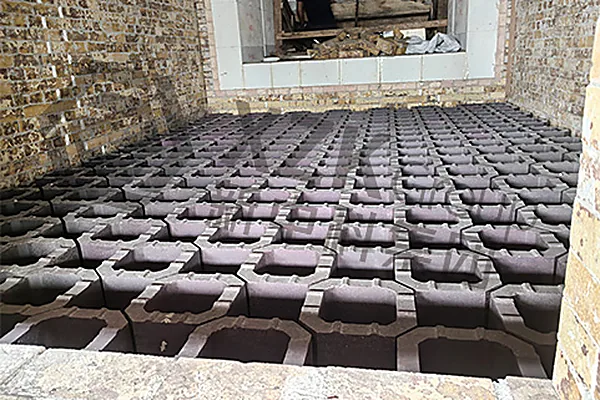
Regenerator checkerwork
Checker bricks are the heat exchanger. Their value lies in surface area per unit volume, stable gas flow and dimensional stability across thousands of reversals.
Standard rectangular, barrel and cylindrical shapes are all produced to layout drawing. See regenerator refractory bricks for the shape and grade matrix.
Typical grades: Mullite checker · SL57-P / SL65-P · cylindrical and barrel shapes
Joints, seals and irregular shapes
Every zone above depends on what happens between the bricks. A two-millimetre joint eroded by glass is a path to the steel shell.
Ramming masses, gunning mixes, low-cement castables and matched mortars close those gaps. They are specified together with the brick, not afterwards.
Typical grades: RM-AZS / RM-ZR ramming masses · low cement castables · ZKM mortars
On Site — Recent Furnace Installations
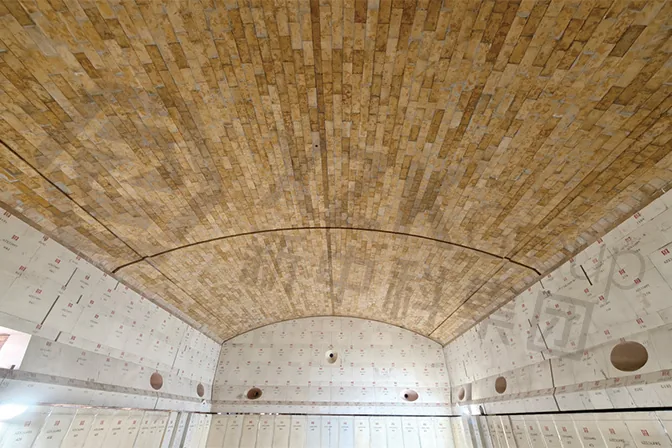
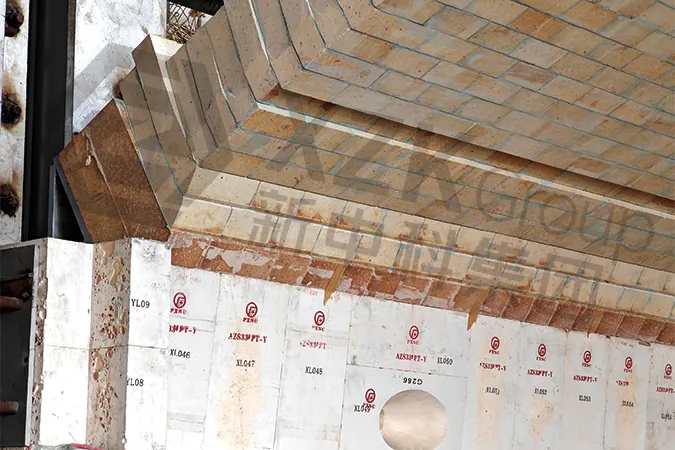
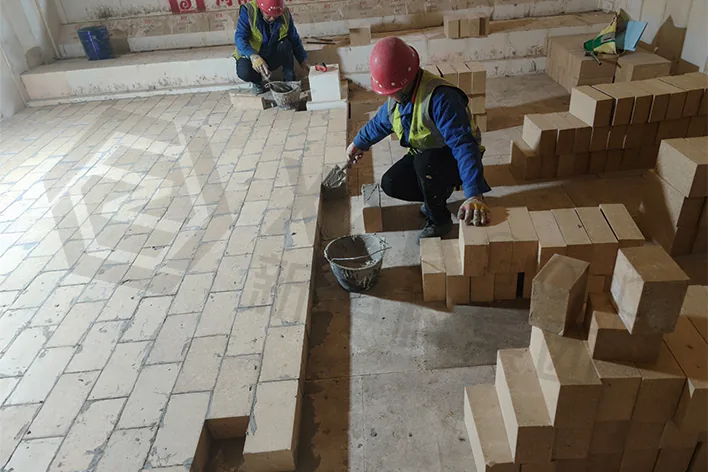
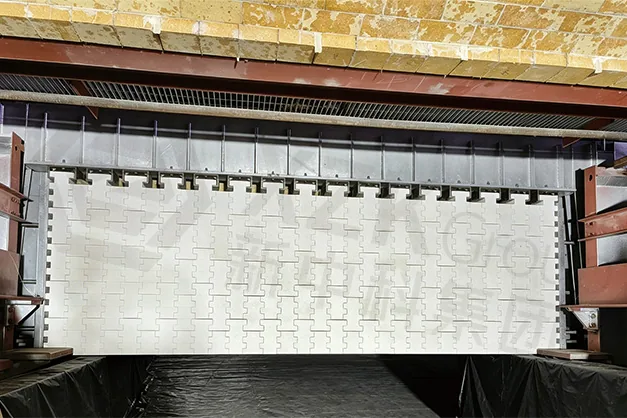
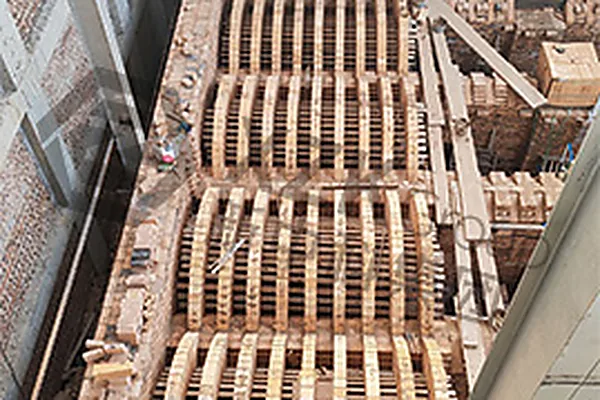
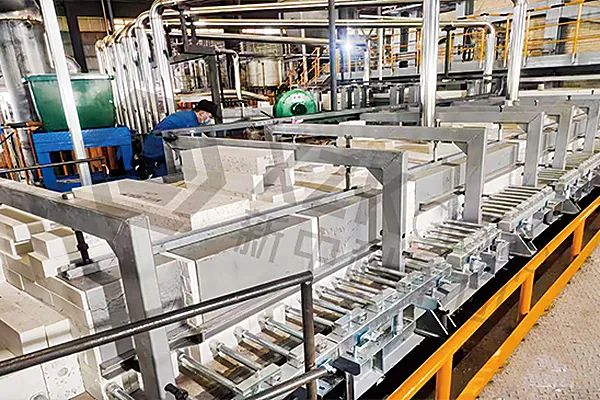
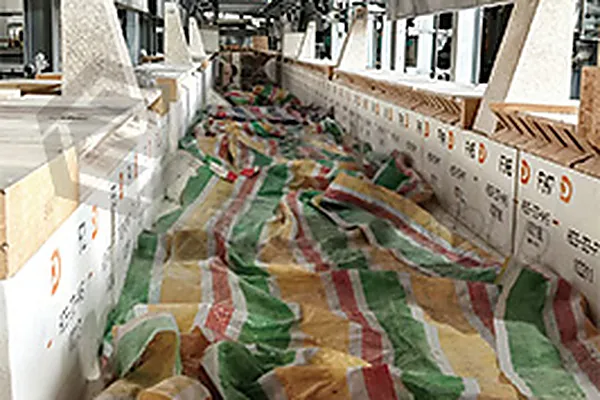
Every photograph below is from a lining we supplied and supported on site. They show what the materials in the tables above look like inside a real furnace — zone by zone, from the crown down to the tank bottom and across to the forehearth.
Failure Mechanisms and How the Lining Answers Them
Every material choice in the tables above exists because of a specific way a lining fails. Recognising the mechanism in your own furnace data is how a grade list becomes a lining design.
The glass surface moves with the level control, wetting a band of brick above and below the mean line. Molten glass dissolves the silicate matrix and the brick is undercut, sometimes into a notch deep enough to threaten the shell.
High-zirconia fused cast AZS at the line (FAZS41), with a wider zirconia-rich band than the nominal fluctuation range, and a dense, controlled glass phase so exudation stays low. Joints are staggered and kept tight.
Soda and potash vapour from the batch condenses in the superstructure and the upper regenerator, reacts with free silica in the brick, and forms low-melting phases that expand as they form. The brick swells, spalls, and in checkerwork the reaction migrates downward through the stack.
Zircon and zircon mullite in the superstructure; zircon mullite and chrome-zirconia-mullite in the condensation zone. Low-silica mullite formulations remove the phase the alkali attacks.
Under sustained load at temperature, a refractory deforms slowly. In a regenerator carrying hundreds of tonnes, that creep accumulates over years until courses shift, joints close and the gas path distorts.
Low-creep mullite and corundum mullite for the base courses and rider arch (creep ≤ 0.3% at 1500°C), with silica removal and a rigorously controlled firing curve to reduce the glassy phase that allows creep in the first place.
Every reversal in a regenerative furnace drives a thermal wave through the checkerwork. Materials with high expansion and low strain tolerance develop crack networks and lose bricks from the surface inward.
Andalusite and sillimanite grades that mullitize in service and hold volume; zircon mullite where alkali resistance is also needed. Thermal shock resistance of 15–25 cycles (1100°C water quench) is the design target.
Bubbles form in the joints between paving bricks, rise, and carry molten glass with them, drilling upward into the floor structure — a failure that progresses invisibly and then quickly.
Two-layer paving with staggered joints, sintered AZS pavers with controlled porosity, and a rammed AZS sealing layer (RM-AZS) fully compacted beneath them.
A perfectly good hot face still fails if the back-up lining loses its insulating value. Densification, joint shrinkage and moisture pick-up all raise thermal conductivity in service and push shell temperature up.
Insulating bricks selected against a cold-face temperature target rather than a hot-face limit, with the build-up (JM series and high alumina insulation) calculated for the actual zone rather than copied from a standard drawing.
How to Select the Lining for Your Furnace
Selection starts from the furnace type and the operating data, not from a favourite product. The matrix below is the starting point our engineers use; the grade for each zone is then confirmed against your actual numbers.
Indicative material selection by furnace type
| Furnace type | Glass contact | Superstructure | Regenerator | Insulation |
|---|---|---|---|---|
| Float glass furnace | Fused cast AZS 36/41, sintered AZS paving | Zircon, corundum mullite | Zircon mullite upper, mullite lower, sillimanite checker | JM26–JM30, lightweight silica crown |
| Container / tableware (end-fired or cross-fired) | Fused cast AZS 33/36, sintered AZS paving | Zircon mullite, corundum mullite | Mullite and andalusite checker, chrome corundum condensation zone | JM23–JM28, high alumina insulation |
| Fibre glass furnace | Fused cast AZS, chrome corundum at the throat | Corundum and corundum mullite | Mullite checker, chrome corundum hot zone | JM26–JM30 |
| Solar / photovoltaic glass furnace | Fused cast AZS 41, chrome corundum throat | Zircon, corundum mullite | Zircon mullite, mullite checker | JM28–JM30, lightweight silica crown |
Indicative only. Pull rate, batch composition, colouring agents (especially chrome and cobalt), furnace age and target campaign life all shift the selection.
Four rules that decide most of the specification:
- Size the zirconia content to the zone, not to the budget. Moving from FAZS33 to FAZS41 across a whole tank wastes money; leaving a flux line under-specified costs a campaign.
- Choose structural grades on creep, not on refractoriness. A regenerator base course is loaded for years; short-duration refractoriness under load tells you very little about how it behaves.
- Match the back-up lining to a cold-face temperature target. Insulation specified by habit is the most common cause of unexplained shell temperature rise.
- Specify the joints with the brick. Ramming masses, castables and mortar come from the same plant as the brick, so expansion and tolerance stay consistent at the interface.
Manufacturing and Quality Control
A glass furnace lining is only as good as the consistency of the bricks in it. Our production is set up so that density and dimensional tolerance are controlled by process rather than by operator judgement.
Four automatic batching lines feed 20 CNC presses ranging from 630 to 2000 tonnes, so brick density is controlled by press force rather than operator judgement. Firing runs through four 108-metre fully automatic tunnel kilns and five ultra-high-temperature shuttle kilns, giving the uniform soak these materials need to complete densification.
Quality control covers the full chain: incoming raw material assay, in-process density and dimensional checks, and finished-brick testing for bulk density, apparent porosity, cold crushing strength and refractoriness under load. Every shipment leaves with a certificate of analysis.
Fused cast material is melted in electric arc furnaces and cast into graphite moulds, then annealed on a controlled cooling schedule so that internal stress does not predetermine where the block cracks. Sintered grades are pressed on CNC presses and fired in fully automatic tunnel kilns, with sampling at every batch for bulk density, apparent porosity, cold crushing strength and refractoriness under load.
XZK Group holds ISO 9001, ISO 14001, ISO 45001 and ISO 50001 certification, is recognised as a National High-Tech Enterprise, and operates the Henan Provincial Engineering Technology Research Centre for Sintered Refractories for Glass Furnaces. We have contributed to standards including JC/T 2574-2020 (Sillimanite bricks for glass furnaces), GB/T 4984-2023 (chemical analysis methods for zirconium-containing refractories) and T/CSTM 00853-2024 (chrome-zirconia-corundum bricks for glass furnace regenerators).
Glass Industry Sectors We Supply
Float glass
Large-tonnage float lines where campaign life is measured in years and a single unplanned repair costs far more than the refractory.
Container and tableware
End-fired and cross-fired furnaces with frequent colour and batch changes, where thermal cycling rather than peak temperature sets lining life.
Fibre glass
Furnaces with aggressive batch chemistry, where throat and electrode area refractories are the limiting factor.
Solar and photovoltaic glass
The fastest-growing segment, with ultra-clear glass and tight defect tolerance placing particular demands on superstructure and forehearth materials.
Frequently Asked Questions
What refractories does a glass furnace need?
A complete lining uses fused cast and sintered AZS in the glass contact area, zircon and zircon mullite in the superstructure and upper regenerator, corundum and chrome corundum at the throat, ports and high-wear positions, mullite and alumina-silica for structural zones and checkerwork, insulating bricks as back-up, and castables, ramming masses and mortar to seal the joints. XZK Group produces all of these in one plant.
Which refractory is best for the glass contact area?
Fused cast AZS. Its cast zirconia-corundum structure is denser and far more resistant to molten glass attack than any pressed brick. Zirconia content is chosen by zone: typically 33% for general side wall, 36% for higher-wear areas and 41% at the flux line and throat.
Why does my regenerator checkerwork fail before the side walls?
Alkali vapour. Between about 800°C and 1100°C, soda and potash condense in the checkerwork and react with free silica in the brick, forming expanding phases that cause spalling and downward drilling. Zircon mullite, chrome-zirconia-mullite and chrome corundum grades are specified against it.
What is the difference between fused cast AZS and sintered AZS?
Fused cast AZS is melted and cast, giving a very dense, glass-contact-grade block with excellent corrosion resistance but lower thermal shock tolerance and higher cost. Sintered AZS is pressed and fired, giving uniform density, no casting cavities, better thermal shock resistance and a lower price — which is why it is used for paving, upper structure and rammed surfaces.
Do you supply the whole lining or single products?
Both. Most customers start with a brick list or a furnace drawing and ask us to review it. Our engineers return a zone-by-zone recommendation covering brick, insulation, monolithics and mortar, and then quote the complete set — one supplier, one set of tolerances, one point of responsibility.
Can you match another manufacturer’s specification?
Yes, where the specification is sound. Send the datasheet; we will confirm whether the grades you have been buying are appropriate for the zones you are using them in, and flag any that are under- or over-specified before quoting a substitute.
What shapes and sizes can you produce?
Standard rectangular and wedge shapes are pressed to drawing, including curved and tapered bricks. Regenerator internals are produced in standard, barrel and cylindrical form. Complex shapes and large blocks are cast. Send a drawing and we will confirm feasibility, tooling and lead time.
What is the lead time and minimum order?
Standard grades typically ship in 25–40 days. Minimum order depends on grade, shape and whether tooling is needed; pressed standard shapes have no practical minimum beyond a full pallet. Common repair shapes are held in stock for faster dispatch.
Why Buy Glass Furnace Refractories from XZK Group
We are a manufacturer, not a trading company. AZS, zircon, corundum, mullite, alumina-silica, insulating and monolithic refractories are all produced in our own plant in Xinmi, Henan — 100,000 tonnes a year across four fully automatic tunnel kilns and five shuttle kilns, with 93 core patents and an in-house testing laboratory. That means one point of responsibility for a complete lining, and one engineering team accountable if a zone underperforms.
Our application engineers have supplied glass manufacturers across Asia, Europe, Africa and the Middle East, including float lines, container plants and fibre glass producers. That field experience is what turns a grade list into a working lining design: we read the furnace, the batch and the pull rate, then specify the zones.
Send us your furnace data — we will map the full lining
A drawing, a brick list or even a photograph of the furnace is enough to start. Our engineers will confirm the right material for every zone, flag any under- or over-specification, and return a quotation within 24 hours.
Related refractory products
This page is the entry point to our glass industry range. From here you can go straight to the family you need: AZS bricks, zircon and zircon mullite bricks, corundum bricks, mullite bricks, regenerator and checker bricks, insulating bricks and monolithic refractories. For a complete zoned solution by furnace type, see the float glass furnace solutions and end-fired furnace solutions pages, or browse the alumina-silica series, corundum series and zirconia series. Individual grades are listed under all refractory products, and our certifications are set out on the quality control page. Ready to specify? Contact our engineers.
 WhatsApp
 WeChat
 WhatsApp
 WeChat