Mullite Insulating Brick

Mullite Insulating Brick

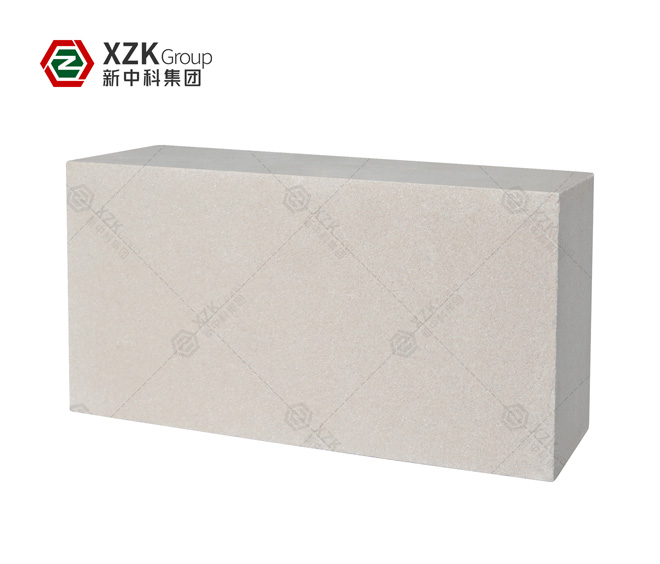
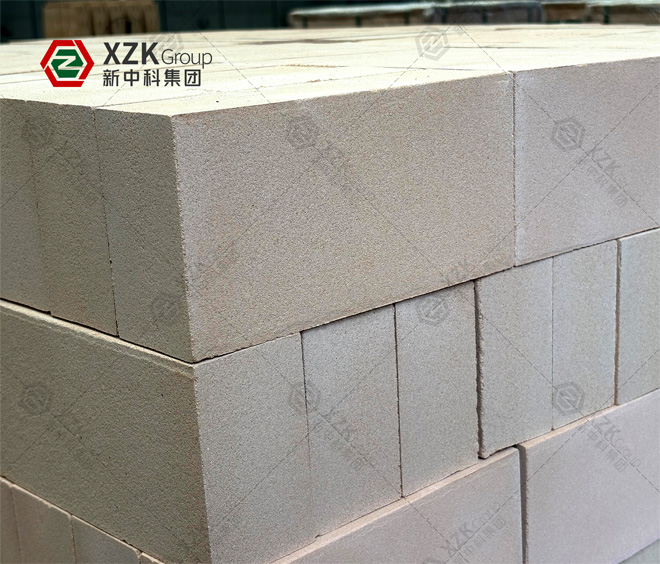
Mullite insulating bricks are lightweight firebricks in which a mullite-alumina aggregate is bonded around a controlled pore network, so the finished brick weighs a fraction of a dense refractory while still holding a mullite crystal phase. XZK supplies four grades - JM23, JM26, JM28 and JM30 -...

Al₂O₃:40-70%
Bulk Density:0.60-1.10g/cm³
Thermal Conductivity:0.20-0.60
Mullite Insulating Brick

Mullite Insulating Brick Overview

Mullite insulating bricks are lightweight firebricks in which a mullite–alumina aggregate is bonded around a controlled pore network, so the finished brick weighs a fraction of a dense refractory while still holding a mullite crystal phase. XZK supplies four grades — JM23, JM26, JM28 and JM30 — spanning 0.6 to 1.1 g/cm3 bulk density, thermal conductivity from 0.19 to 0.43 W/(m·K) at 350°C and cold crushing strength from 1.5 to 3.5 MPa. The family exists to solve one problem in a glass furnace: cut the heat escaping through the shell without adding deadweight to the structure that sits above the melt.

XZK Group manufactures the JM series at our Xinmi plant in Henan. In glass furnaces these bricks form the insulation course behind dense working linings — crown insulation above a silica or mullite arch, tank bottom insulation under the paving, the external casing of the regenerator, the backing of a suspended wall, the doghouse and the forehearth.

What Is a Mullite Insulating Brick?

The body is built from mullite and alumina aggregate held in a ceramic bond, with the pore network produced deliberately rather than left over from firing. In a dense firebrick porosity is a defect; in an insulating brick it is the functional phase. Lightweight aggregate, a graded fines fraction and a burn-out pore former are combined so that the pores stay small and evenly distributed, because a body of many small closed pores insulates better, and holds together better, than one with a few large open voids.

Alumina content separates the grades. JM23 runs at 42% Al2O3 and JM30 at 72%; as alumina rises, service temperature and mechanical strength rise with it, but thermal conductivity rises too, because the denser mullite–corundum structure conducts more heat than a highly porous body. Iron oxide is held between 0.55% and 1.2% so the insulation course does not introduce a low-melting phase of its own.

JM23, JM26, JM28 and JM30 are the industry-standard designations for this family of mullite insulating firebrick. That is commercially useful rather than cosmetic: a specification, a zoning drawing or another supplier's data sheet written around one of these designations can be quoted directly as an equivalent XZK grade, so a furnace rebuild is not re-engineered simply because a material has been withdrawn.

The three governing numbers — bulk density, thermal conductivity and cold crushing strength — move together, and the real design decision is where on that line a given position belongs. Lower density gives lower conductivity and less weight on the arch, but also less strength. Higher density gives a block that can carry a load, at the cost of conducting more heat. In practice the lightest grade goes outermost, where it is cool and nothing rests on it, and the densest grade is placed where the brick has to bear weight.

Key Properties

  • Bulk density 0.6–1.1 g/cm3 — JM23 at 0.6, JM28 at 0.7, JM26 at 0.8 and JM30 at 1.1 — against roughly 2.5 g/cm3 for a dense firebrick, so an insulation course adds a small fraction of the deadweight of the working lining.
  • Thermal conductivity 0.19–0.43 W/(m·K) at 350°C, with the lowest figure in JM23 and the highest in JM30. This is the property that sets the shell temperature and the fuel bill, not the refractoriness of the hot face.
  • Cold crushing strength from ≥ 1.5 MPa (JM23) to ≥ 3.5 MPa (JM30), chosen together with density so that a block in a load-bearing position is not specified lighter than the structure above it can tolerate.
  • Alumina content from 42% (JM23) to 72% (JM30), which sets how close to the working lining each grade may be placed and how it behaves in contact with alkali vapour carried in the flue gas.
  • Low iron oxide, from ≤ 1.2% in JM23 down to ≤ 0.55% in JM30, so the insulation layer cannot become the source of a liquid phase that would soften it or stain the glass.
  • Stable volume and good thermal shock tolerance, because an insulation course behind a cycling crown must not crack and open a path for hot gas to bypass the working lining.

Technical Specifications

Technical Properties XZK-JM23 XZK-JM26 XZK-JM28 XZK-JM30
Al₂O₃ (%) 42 45 54 72
Fe₂O₃ (%) ≤ 1.2 ≤ 1.0 ≤ 0.9 ≤ 0.55
Bulk Density (g/cm³) 0.6 0.8 0.7 1.1
Cold Crushing Strength (MPa) ≥ 1.5 ≥ 2.3 ≥ 2.0 ≥ 3.5
Thermal Conductivity (350℃, W/(m·K)) ≤ 0.19 ≤ 0.24 ≤ 0.21 ≤ 0.43

Test methods follow GB/T and ISO practice; ASTM equivalents and full certificates of analysis are issued with every shipment.

Available Grades and How to Choose

Grade selection begins with the temperature and the mechanical duty at the insulation course, not at the hot face. Insulation that is two courses back from the melt never sees the temperature printed on the working brick, and specifying by hot-face temperature alone leads to an unnecessarily heavy and expensive block.

The four grades sit at different points on the density–conductivity–strength line. It is worth noting that JM28 is lighter than JM26 but carries more alumina; where the position needs alumina rather than strength, JM28 is the correct choice, and where it needs strength the denser grade is correct even if it conducts more.

  • XZK-JM23 — 42% Al2O3, 0.6 g/cm3, thermal conductivity ≤ 0.19 W/(m·K), cold crushing strength ≥ 1.5 MPa. The lightest and most insulating grade, for the outermost course where nothing bears on the brick.
  • XZK-JM26 — 45% Al2O3, 0.8 g/cm3, ≤ 0.24 W/(m·K), ≥ 2.3 MPa. A middle course between JM23 and JM28 where a little more load capacity is wanted.
  • XZK-JM28 — 54% Al2O3, 0.7 g/cm3, ≤ 0.21 W/(m·K), ≥ 2.0 MPa. Higher alumina at low density, for positions where flue-gas chemistry rather than load governs the choice.
  • XZK-JM30 — 72% Al2O3, 1.1 g/cm3, ≤ 0.43 W/(m·K), ≥ 3.5 MPa. The strongest grade, placed closest to the working lining where temperature, load and the first contact with alkali vapour are all highest.

Industry Applications

Mullite Insulating Bricks are widely used in the linings and thermal-insulating layers of high-temperature equipment such as glass kilns, metallurgical hot blast stoves, ceramic roller kilns, and petrochemical cracking furnaces, especially in environments without molten liquid erosion.

Where Mullite Insulating Bricks Are Used in a Glass Furnace

Insulating brick is never the hot face; it is the layer that decides how much heat escapes. In a glass furnace the JM series appears in six positions, each for a different reason.

  • Crown insulation. The decisive application. A silica or mullite crown radiates from a large area, and every kilogram of insulation added to the arch has to be carried by the arch itself, so the material must be both thermally effective and light. Advanced crown insulation designs hold heat loss below 1250 W/m2, and optimised designs below 1050 W/m2, by placing the lightest available brick above the working course; the mullite insulating brick supplies the low conductivity and low mass that make those figures achievable without overloading the springing line.
  • Tank bottom insulation. Under the paving and sub-layer courses, a mullite insulating course cuts downward loss into the bottom structure and keeps the steel shell within its temperature limit. It works in the same stack as high alumina insulating brick where a stronger block is required adjacent to the structural courses.
  • Regenerator casing and exterior wall. The regenerator casing is one of the largest radiating surfaces in the furnace. Insulating brick behind the dense low-porosity clay or chrome corundum working course reduces shell loss and raises the external steel temperature above the acid dew point, which is what prevents sulphate condensation on the casing.
  • Suspended wall. In a suspended wall the insulation hangs with the working brick, so mass is a direct structural penalty. The lightest JM grades back a dense silicon mullite or corundum mullite panel and reduce the tension the anchors must carry.
  • Doghouse and charging ports. The doghouse lining cycles with every batch charge, and a light backing layer flattens the thermal gradient through the wall instead of letting it concentrate in the working brick.
  • Forehearth insulation. Forehearth sidewalls and covers are insulated to hold glass temperature constant along the channel; at these moderate temperatures a thin, low-conductivity course is sufficient.

Manufacturing and Quality Control

The JM series is produced from lightweight mullite and alumina aggregate with a controlled pore-forming addition. Four automatic batching lines feed 20 CNC presses from 630 to 2000 tonnes, so green density is set by press force rather than operator judgement, and firing runs through four 108-metre fully automatic tunnel kilns and five ultra-high-temperature shuttle kilns. Because an insulating brick is judged on a low and repeatable density, the kiln schedule is held constant batch to batch and the burn-out of the pore former is completed slowly enough that the pore structure does not collapse.

Each production batch is tested for bulk density, cold crushing strength and thermal conductivity at 350°C, and ships with a certificate of analysis that states the measured values rather than nominal ones. XZK Group holds ISO 9001, ISO 14001, ISO 45001 and ISO 50001 certification and operates the Henan Provincial Engineering Technology Research Center for Sintered Refractories for Glass Furnaces.

Related Refractory Products

The JM series is specified as one layer of a complete insulation stack, normally together with lightweight silica bricks on a silica crown, high alumina insulating bricks and clay insulating bricks lower in the structure, and alumina bubble bricks where the backing layer must itself survive high temperature. The dense working courses above them are usually mullite bricks or sillimanite bricks. See the insulating bricks range for zoning guidance or browse all refractory products.

Proven Global Projects

About XZK Group

Strengths
Innovation
R&D Team
Facilities
Honors
Product Portfolio
Specializing in premium zircon, corundum, sintered AZS, and monolithics. With a $70M+ annual output, we deliver durable linings for global high-temp industries.
Capacity
✔ 4 automated microcomputer batching systems.
✔ 4 ultra-high-temp tunnel kilns & 5 shuttle kilns.
✔ 20+ CNC hydraulic presses (630-1500T).
✔ Digitalized workshops with 100,000T annual capacity.
Core Strengths
Core Strengths
Core Strengths
Core Strengths
Core Strengths
💡
93 patents, featuring the "Tri-Resist Brick" for glass kilns. Field-proven for superior corrosion and thermal shock resistance.
📜
Co-authored multiple National Standards for Andalusite, Chrome-Corundum, and Zircon bricks with CBMA.
🤝
Strategic partner to Fortune 500 leaders: China Baowu, CNBM, CSG, Xinyi, and Kibing Glass.
Tech & Innovation
Tech & Innovation
Tech & Innovation
Expert R&D Team
Led by Prof. Shi Gan, our 40+ engineers leverage advanced testing centers to drive innovation in green refractory technologies.
Professor Shi Gan
Prof. Shi Gan
Chief Scientist
Senior Engineer & National Expert (State Council Allowance).
Key drafter of 5+ national refractory standards.
Inventor of "Tri-Resist Brick", maximizing glass furnace lifespan.
R&D Center
Laboratory Equipment
Zhongke Refractories
Insulating Materials Base: Alumina Bubble, Mullite, High-Alumina & Fireclay bricks.
Zhongke New Materials
Special Refractories Base: Chrome-Corundum, Tri-Resist, and Low-Porosity bricks.
Henruida New Materials
Premium Refractories Base: Zircon, Corundum, Sintered AZS, and monolithics.
Zhengzhou Zhongke Refractories Co., Ltd. Zhengzhou Zhongke New Materials Co., Ltd. Zhengzhou Henruida New Materials Co., Ltd.
Certifications & Honors

Certified by ISO 9001, 14001, 45001, 50001 Management Systems.

Honored as:

  • National High-Tech Enterprise
  • Specialized & Innovative SME
  • Provincial Green Factory
  • Grade A Environmental Enterprise
Certifications & Honors
Beginning with professional consultation to accurately identify and address specific requirements
One-to-one Service
We offer one-on-one dedicated sales and technical team services to perfectly solve any refractory material problems you encounter
Professional Solution
The company has over 30 technical R&D personnel and can provide professional solutions based on the on-site conditions of customers
Quality Management System
We have a strict quality management system to ensure the stability of the quality of each batch of products.
Responsible After-sales Service
Our dedicated technical team will visit customers regularly and provide free lifetime after-sales service
leave a message for refractory
Contact Us
Phone/WhatsApp/Wechat: 0086 19059612888
Add: Micun & Laiji Refractory Industry Zone, Xinmi City, Henan Province, China
WhatsApp of XZK refractory WhatsApp

WeChat of XZK refractory WeChat

Leave a message
Please submit your inquiry using the form provided below. We will offer you a solution and quotation within 24 hours.

    CONTACT US
    To ensure we provide you with the best possible
    solution, please share:
    1. Type of refractory product you are interested in.
    2. Specific requirements (e.g., dimensions, quantity, using temp).
    3. Your industry or application area – this helps us
    tailor the ideal solution for you.
    Tel/WhatsApp/Wechat:
    0086 19059612888
    WhatsApp
    WeChat
    LEAVE A MESSAGE
    Please feel free to submit your inquiry using the form provided below, and we will provide you with a quote within 24 hours.

      WhatsApp

      WhatsApp ID: +86 190 5961 2888

      Email
      WeChat

      WeChat ID: +86 190 5961 2888

      Telephone