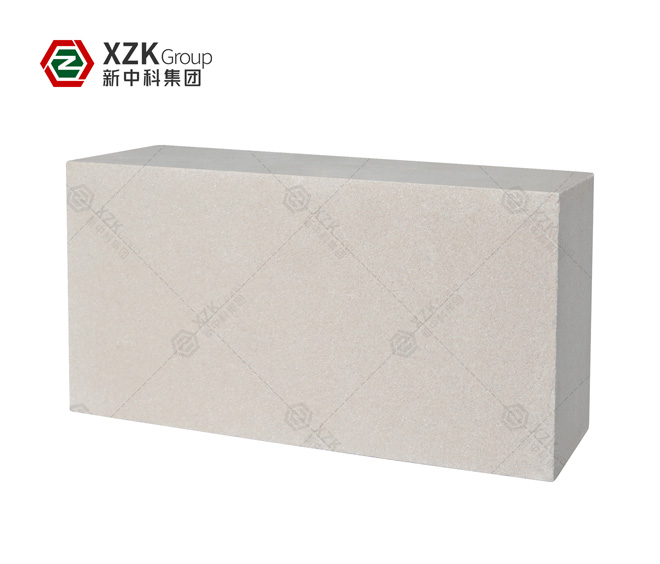
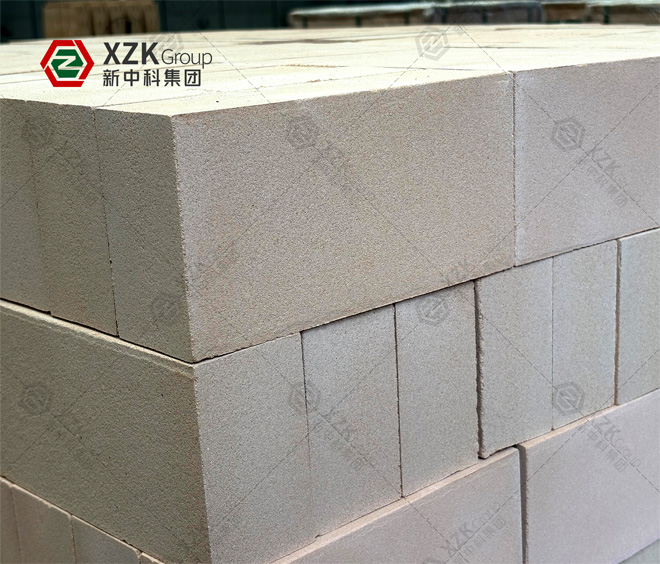
Lightweight clay insulating bricks are fireclay-based insulators in which graded fireclay grog is bonded around a controlled pore structure. They provide the outer insulation course of a refractory stack at the lowest material cost of any of the lightweight families on our line. XZK supplies the LC series in bulk densities from 0.6 to 1.3 g/cm3, with thermal conductivity from 0.25 to 0.55 W/(m·K) at 350°C and cold crushing strength from 1.5 to 8.0 MPa.
XZK Group produces grades XZK-LC135-1.3, LC135-1.0, LC125-0.8 and LC120-0.6 at our Xinmi plant in Henan. They close the insulation stack behind regenerator casings, breastwalls, suspended walls, forehearths and the doghouse, and they back the high alumina and mullite insulating courses where those take the higher temperature.
What Is a Clay Insulating Brick?
The raw material is fireclay, the same base material as an ordinary dense fireclay brick, but the body is built to a target density rather than to maximum density. Fireclay grog of a controlled grading supplies the refractory skeleton and the fired bond, while a pore-forming addition and a low forming pressure hold the structure open. The result is a brick that behaves like fireclay in service — it is chemically stable, dimensionally predictable and tolerates thermal cycling — but weighs a fifth to a half as much.
In the LC grade code, the trailing figure states the target bulk density in g/cm3, so LC135-1.3 is a 1.3 g/cm3 brick and LC120-0.6 is the lightest in the range. That direct naming is deliberate, because density is the number that governs both the insulation value and the strength of the brick, and the specification is easier to read and to check when it is written on the grade.
The justification for a fireclay insulator rather than an alumina one is economic rather than technical. In the outer courses of a furnace wall the temperature is low, the atmosphere is no longer aggressive, and nothing is in contact with the melt. An alumina body offers more refractoriness than that position needs and costs more to produce. Fireclay insulation performs the insulation duty at lower cost, and the money saved is better spent on the working course where the service conditions are severe.
The trade-off is the same density–conductivity–strength line that governs every insulating brick, and the LC range is wide enough to cover both ends. The 1.3 g/cm3 grade reaches 8.0 MPa and a conductivity of 0.55 W/(m·K); the 0.6 g/cm3 grade gives 1.5 MPa and 0.25 W/(m·K). A position that carries a load takes the dense grade; a position that only stops heat takes the light one.
Key Properties
- Bulk density from ≤ 0.6 to ≤ 1.3 g/cm3, named directly in the grade code so the specified figure is visible on the drawing.
- Thermal conductivity from ≤ 0.25 to ≤ 0.55 W/(m·K) at 350 ± 25°C, covering the full range from a light closing course to a load-bearing backing brick.
- Cold crushing strength from ≥ 1.5 MPa (LC120-0.6) to ≥ 8.0 MPa (LC135-1.3), so the same family can back a structure or simply blanket it.
- Fireclay chemistry that is stable and predictable in the lower-temperature, lower-aggression zones of the furnace where an alumina body would be unnecessary.
- Low permanent linear change, so the insulation course does not shrink away from the working lining and leave a gap for hot gas to channel through.
- Good thermal shock tolerance, appropriate for casing and backing positions that follow the furnace through heat-up and each reversal without cracking.









 WhatsApp
 WeChat
 WhatsApp
 WeChat