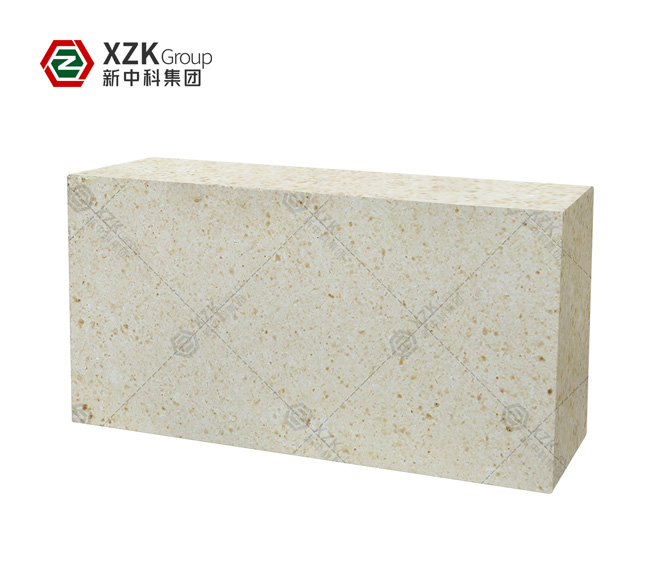
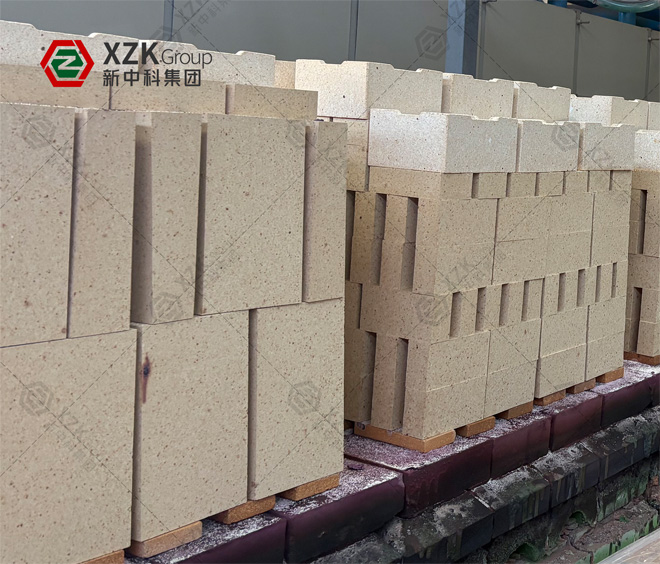
High alumina bricks in the XZK-SK series are the standard workhorse refractories of the alumina-silica family, with Al2O3 contents of 55%, 65%, 70% and 82% and refractoriness expressed on the Orton cone scale as SK36, SK37, SK38 and SK40. They are the brick to specify for structural and backing positions where the duty is high temperature and moderate chemistry rather than direct glass contact.
XZK Group presses the SK series on the same CNC presses and fires it in the same tunnel kilns as the rest of our alumina-silica range, so the four grades are delivered to the same dimensional and density tolerances as our premium sintered products.
What the SK Grading Means
High alumina bricks sit between fireclay and the mullite-corundum materials. As Al2O3 rises from 55% to 82%, the mineralogy shifts from a clay-bonded mullite body towards a mullite-rich, corundum-bearing structure, and refractoriness under load rises with it from 1450°C at SK36 to 1550°C at SK40. Bulk density climbs from the 2.25–2.40 g/cm3 band to 2.50–2.70 g/cm3, and cold crushing strength from 45 MPa to 70 MPa.
The SK number is the pyrometric cone equivalent, obtained by comparing the deformation of a test cone against a standard Orton cone. It is a direct measure of refractoriness, and it is the traditional way the glass and steel industries name these bricks, which is why XZK keeps the SK designation alongside the chemical grade.
Manufacture is conventional high-alumina practice: bauxite and clay raw materials, graded aggregate, automatic batching, high-pressure pressing and firing to a controlled curve. Because these bricks are produced in volume for many positions, consistency between batches matters as much as peak performance, and density is set by press force rather than by operator judgement.
Key Properties
- Four alumina grades from 55% to 82% Al2O3, so a furnace can be zoned without changing material family.
- Refractoriness on the Orton cone scale from SK36 to SK40, rising with alumina content.
- Refractoriness under load of 1450–1550°C at 0.2 MPa, sufficient for superstructure backing and regenerator walls.
- Bulk density of 2.25–2.70 g/cm3 and cold crushing strength from 45 to 70 MPa across the series.
- Iron content controlled to 2.0% Fe2O3 or below in every grade.
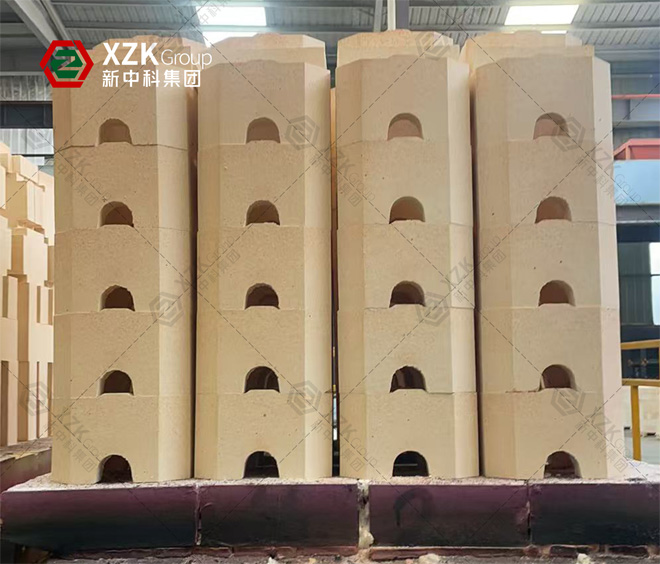
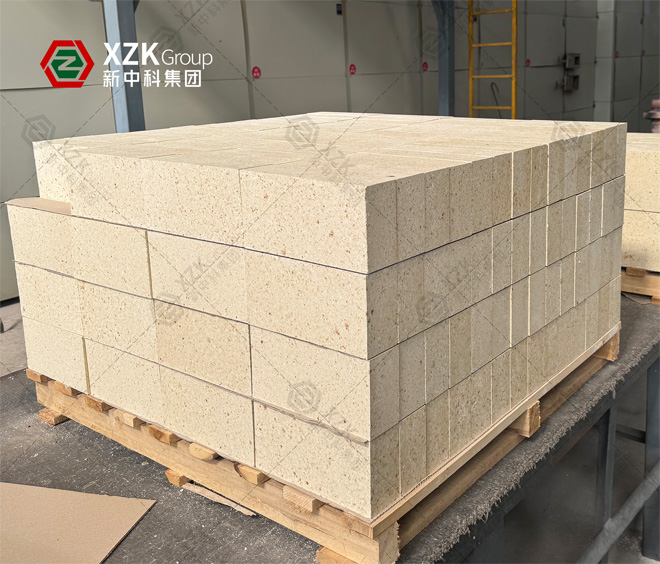
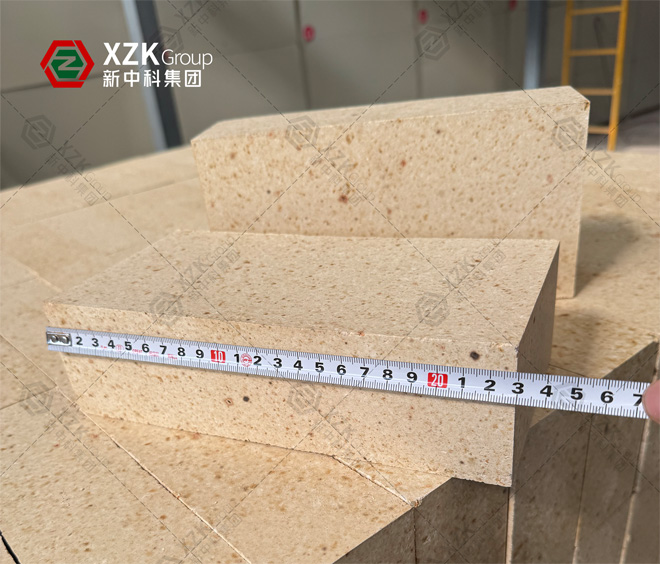
- Widely available in standard shapes, with a broad range of sizes for backing and filler courses.








 WhatsApp
 WeChat
 WhatsApp
 WeChat