

AZS Bricks
The refractory that faces molten glass directly — fused cast 33#, 36# and 41# for the flux line, sintered AZS for superstructure and backup.
AZS is the refractory that actually touches molten glass. Where corundum, mullite and zircon handle structure, alkali and insulation, AZS handles the melt itself — which is why it occupies the most critical positions in a glass tank: the flux line, the throat, and the bottom paving.
XZK Group supplies both AZS families. Fused cast AZS in 33#, 36# and 41# grades covers the glass contact and high-corrosion positions; sintered AZS covers superstructure, backup and applications where exudation risk cannot be tolerated. AZS ramming mass completes the bottom sealing system.
Because fused cast and sintered AZS behave differently in service, choosing between them is a design decision rather than a price decision — and it is the decision that most often determines whether a tank reaches its designed campaign life.
Fused Cast and Sintered AZS — What’s the Difference?
AZS stands for alumina-zirconia-silica: a three-phase refractory built from corundum, zirconia and a silicate glass phase. The zirconia fraction is what gives AZS its resistance to molten glass — it is chemically attacked far more slowly than alumina alone.
Fused cast AZS is melted in an electric arc furnace and poured into moulds, producing large blocks with a coarse crystalline structure and a vitreous phase. Sintered AZS is made from zircon and industrial alumina by high-pressure pressing and high-temperature sintering, producing a finer, more uniform microstructure with no glass phase.
Why the glass phase matters
The vitreous phase that gives fused cast AZS some of its properties is also its principal limitation: at high temperature it can exude from the brick, and in the superstructure an exuding brick releases droplets into the glass melt, causing stone and cord defects. Sintered AZS has no glassy phase to exude. That distinction is the reason both families exist, and why the choice depends on position rather than simply on performance figures.
Types and Grades of AZS Bricks
Three families cover AZS duty in a glass furnace. The fused cast grades differ in zirconia content, which is what determines where in the tank each is used.

Flux line & sidewalls
Fused Cast AZS 41#
XZK-FAZS41
The highest zirconia grade, with ZrO2 ≥ 41% and the lowest glass phase exudation in the range. Specified for the flux line and sidewall where chemical attack from the melt is most severe and the highest density is required.
ZrO2 ≥ 41.0% · Density ≥ 3.95 g/cm3 · Exudation ≤ 2.5%
General glass contact
Fused Cast AZS 36#
XZK-FAZS36
The balanced grade. ZrO2 ≥ 36% with density to 3.80 g/cm3 and cold crushing strength above 300 MPa. Used through the sidewall and bottom paving where both corrosion resistance and structural strength are required.
ZrO2 ≥ 36.0% · Density ≥ 3.80 g/cm3 · CCS ≥ 300 MPa
Bottom paving
Fused Cast AZS 33#
XZK-FAZS33
The lower zirconia grade, with the best thermal shock behaviour of the fused cast family and the lowest exudation figure at ≤ 2.0%. Used in bottom paving and positions where thermal cycling during charging is significant.
ZrO2 ≥ 32.5% · Exudation ≤ 2.0% · CCS ≥ 300 MPa
No glass phase
Sintered AZS Brick
XZK-SAZS30
Produced from zircon and industrial alumina by pressing and sintering, giving a uniform microstructure with no vitreous phase. Because it cannot exude, it is preferred in superstructure positions and as a backup layer behind fused cast blocks.
ZrO2 ≥ 30% · Al2O3 ≥ 48% · Density ≥ 3.2 g/cm3
Bottom sealing
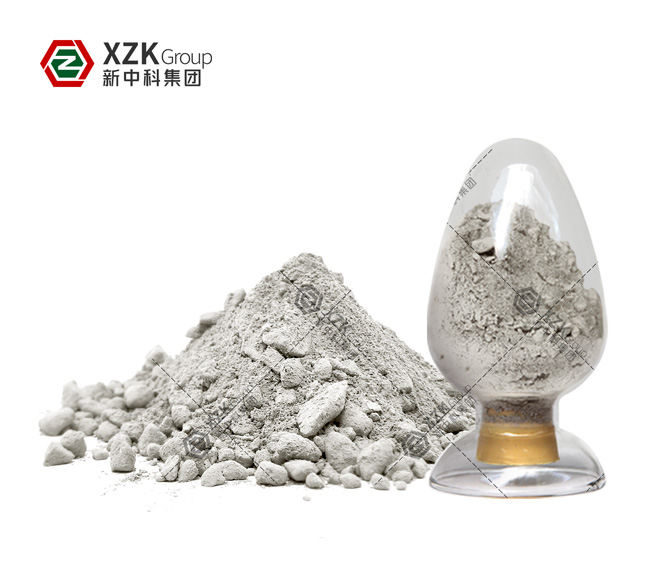
AZS Ramming Mass
XZK-RM-AZS
AZS-based monolithic for the sub-layer beneath bottom paving. Fills the joints and geometry that block cannot seal, working with zircon ramming mass to complete the barrier against melt penetration.
ZrO2 ≥ 30% · Al2O3 ≥ 50% · Density ≥ 2.85 g/cm3
Throat & doghouse
Fused Cast AZS Special Shapes
Cast to drawing
Throat blocks, doghouse corner blocks, electrode blocks and other complex geometries are cast in AZS to customer drawings. These are the highest-wear positions in the tank and require both the material and the geometry to be right.
Cast to drawing — throat, doghouse corner, electrode and port neck blocks.
Technical Specifications
Fused cast AZS is specified on zirconia content, density and glass phase exudation together. Exudation is the figure most often overlooked, and the one that causes glass defects in the superstructure.
Fused cast AZS bricks
| Property | XZK-FAZS33 | XZK-FAZS36 | XZK-FAZS41 |
|---|---|---|---|
| Al2O3 (%) | ≥ 50.0 | ≥ 48.0 | ≥ 45.0 |
| ZrO2 (%) | ≥ 32.5 | ≥ 36.0 | ≥ 41.0 |
| SiO2 (%) | ≤ 14.0 | ≤ 14 | ≤ 13.0 |
| Na2O (%) | ≤ 1.5 | ≤ 1.4 | ≤ 1.3 |
| Bulk density, dense part (g/cm3) | ≥ 3.75 | ≥ 3.80 | ≥ 3.95 |
| Bulk density, PT/QX (g/cm3) | 3.4 | / | / |
| Bulk density, MS/ZWS (g/cm3) | 3.6 | 3.7 | 3.85 |
| Bulk density, WS (g/cm3) | 3.7 | 3.75 | 3.9 |
| Cold crushing strength (MPa) | ≥ 300 | ≥ 300 | ≥ 300 |
| Refractoriness under load, T0.5 (°C) | ≥ 1700 | ≥ 1700 | ≥ 1700 |
| Glass phase exudation (%), 1500°C × 16 h | ≤ 2.0 | ≤ 3.0 | ≤ 2.5 |
Sintered AZS brick and AZS ramming mass
| Property | XZK-SAZS30 (Sintered) | XZK-RM-AZS (Ramming Mass) |
|---|---|---|
| Al2O3 (%) | ≥ 48 | ≥ 50 |
| ZrO2 (%) | ≥ 30 | ≥ 30 |
| Fe2O3 (%) | ≤ 0.5 | — |
| Bulk density (g/cm3) | ≥ 3.2 | ≥ 2.85 |
| Apparent porosity (%) | ≤ 17 | — |
| Cold crushing strength (MPa) | ≥ 90 | ≥ 20 (110°C) / ≥ 40 (1200°C) |
| Refractoriness under load (0.2 MPa, T0.6, °C) | ≥ 1620 | — |
Test methods follow GB/T and ISO practice; ASTM equivalents and full certificates of analysis are issued with every shipment.
Where AZS Bricks Are Used in a Glass Furnace
AZS occupies the positions where the brick must face molten glass. Each of those positions has a different balance of chemical attack, mechanical erosion and thermal cycling.
Flux line and sidewall
The flux line is the most aggressive position in a glass tank. Molten glass circulates against the wall under simultaneous chemical attack and mechanical scour, and the brick is partly submerged and partly exposed. The highest zirconia grade is specified here for maximum corrosion resistance and lowest exudation.
Typical grades: XZK-FAZS41, XZK-FAZS36
Tank bottom paving
Bottom paving faces upward drilling from heavy metal contaminants settling out of the batch, plus thermal cycling as batch is charged. AZS 33# offers the best combination of corrosion resistance, thermal shock tolerance and low exudation for this position, usually in combination with zircon paving and ramming mass layers beneath.
Typical grades: XZK-FAZS33, XZK-FAZS36
Throat and throat blocks
The throat is the narrowest passage in the tank and carries the highest melt velocity. It combines intense thermal shock with severe mechanical abrasion. Throat blocks are cast to drawing in AZS so both geometry and material are optimised for this single, critical position.
Typical grades: XZK-FAZS41 / FAZS36 cast special shapes
Doghouse and charging area
Charging introduces cold batch against hot brickwork, producing repeated thermal cycling, while batch dust and raw material cause abrasion. Doghouse corner blocks are cast in AZS to drawing, with the geometry designed to protect the joint pattern.
Typical grades: Cast doghouse corner blocks, XZK-FAZS36
Superstructure — where sintered AZS wins
Fused cast AZS used in the superstructure can exude glassy phase at high temperature, releasing droplets that become stone or cord defects in the finished glass. Sintered AZS has no vitreous phase, so it cannot exude — which is why it is increasingly preferred for superstructure positions, particularly where batch dust erosion dominates.
Typical grades: XZK-SAZS30
Backup and sub-layer behind fused cast
Behind the fused cast working face, sintered AZS provides a stable backup layer and a second barrier. Because it will not exude, it is a safe choice for any position where a glassy phase would be a defect risk.
Typical grades: XZK-SAZS30, XZK-RM-AZS (sealing layers)
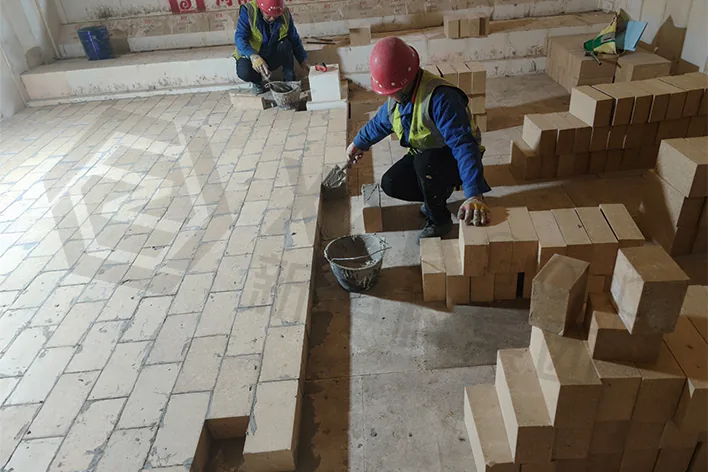
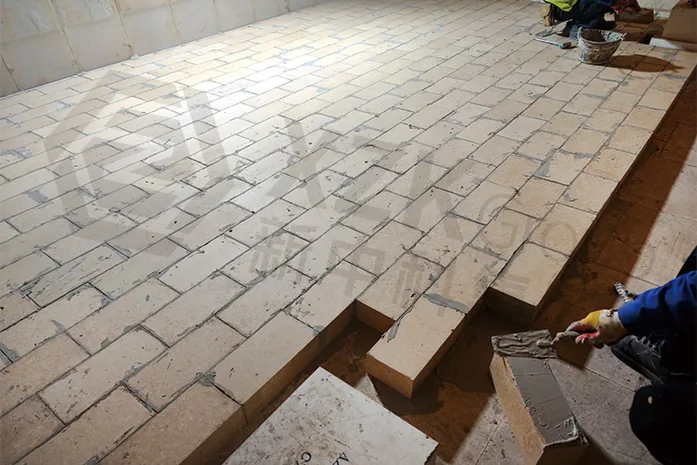
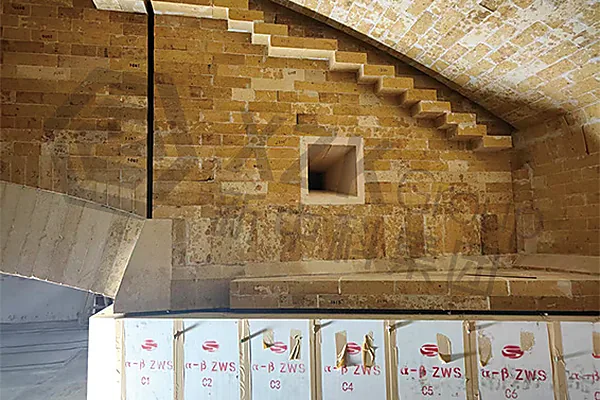
On Site — AZS in the Glass Contact Zone
Paving, side wall and corner work from recent projects, where fused cast and sintered AZS carry the glass contact duty.
AZS Failure Mechanisms and How to Specify Against Them
AZS is engineered to resist molten glass — but it is not immune to every mechanism, and specifying it as a universal solution is a common and expensive mistake.
How to Choose Between Fused Cast and Sintered AZS
The decision rests on three questions: does the brick touch the melt, can it exude into the melt, and what is the dominant wear mechanism at that position.
| Position | Melt contact | Exudation risk | Specify |
|---|---|---|---|
| Flux line, sidewall | Yes, severe | Not critical | Fused cast AZS 41# |
| Sidewall, general | Yes | Not critical | Fused cast AZS 36# |
| Bottom paving | Yes | Not critical | Fused cast AZS 33# / 36# |
| Throat and throat blocks | Yes, highest velocity | Not critical | Fused cast AZS 41#, cast to drawing |
| Doghouse corner | Yes, cycling | Not critical | Fused cast AZS 36#, cast blocks |
| Superstructure, dust erosion | No | Critical | Sintered AZS (no glass phase) |
| Superstructure, alkali dominated | No | Critical | Sintered AZS, or zircon mullite |
| Backup layer behind fused cast | Indirect | Critical | Sintered AZS |
Three practical rules:
- Never specify fused cast AZS in the superstructure without checking exudation. It is the most common AZS mistake, and the defect it causes appears in the finished glass rather than in the furnace — which makes it expensive and slow to diagnose.
- Higher zirconia is not always the right answer. AZS 41# resists melt attack best but AZS 33# handles thermal cycling better. Matching grade to mechanism outperforms specifying the top grade everywhere.
- Design the joints, not just the blocks. Most AZS linings fail at joints rather than in the block. Laying drawings, joint thickness and sealing mass selection are part of the specification, not afterthoughts.
Manufacturing and Quality Control
Fused cast AZS quality depends on casting and cooling control as much as on chemistry — the cooling rate determines the block’s internal structure and therefore its exudation behaviour in service.
Four automatic batching lines feed 20 CNC presses ranging from 630 to 2000 tonnes, so brick density is controlled by press force rather than operator judgement. Firing runs through four 108-metre fully automatic tunnel kilns and five ultra-high-temperature shuttle kilns, giving the uniform soak these materials need to complete densification.
Quality control covers the full chain: incoming raw material assay, in-process density and dimensional checks, and finished-brick testing for bulk density, apparent porosity, cold crushing strength and refractoriness under load. Every shipment leaves with a certificate of analysis.
Fused cast grades are melted in electric arc furnaces and poured into graphite or sand moulds, then annealed under a controlled cooling schedule. Sintered AZS is produced from zircon and industrial alumina by high-pressure pressing and high-temperature sintering, giving a finer microstructure with no vitreous phase. Both routes are verified for zirconia content, bulk density, apparent porosity and glass phase exudation before shipment.
XZK Group holds ISO 9001, ISO 14001, ISO 45001 and ISO 50001 certification, is recognised as a National High-Tech Enterprise, and operates the Henan Provincial Engineering Technology Research Centre for Sintered Refractories for Glass Furnaces. We have contributed to standards including JC/T 2574-2020 (Sillimanite bricks for glass furnaces), GB/T 4984-2023 (chemical analysis methods for zirconium-containing refractories) and T/CSTM 00853-2024 (chrome-zirconia-corundum bricks for glass furnace regenerators).
Industries We Serve
Glass
Melting tank flux line, sidewalls, bottom paving, throats, doghouse corners and superstructure in float, container and fibre glass furnaces.
Iron and steel
High-corrosion positions in steelmaking vessels where AZS chemistry offers advantages over conventional alumina refractories.
Non-ferrous metals
Furnace linings in aluminium and copper processing where resistance to molten metal and slag is required.
Waste and energy
Slagging gasifiers and waste melting furnaces where extreme corrosion resistance is the governing requirement.
Frequently Asked Questions
What does the 33#, 36# and 41# designation mean in AZS brick?
It refers to zirconia content. AZS 33# contains around 33% ZrO2, 36# around 36% and 41# around 41%. Higher zirconia content gives better resistance to molten glass but reduces thermal shock tolerance, which is why the grades are used in different positions rather than one being universally superior.
Why is sintered AZS preferred in the superstructure?
Because it cannot exude. Fused cast AZS contains a vitreous phase that can be released at high temperature; in the superstructure those droplets fall into the melt and become stone or cord defects in the finished glass. Sintered AZS is ceramically bonded with no glassy phase, so it is safe in positions where exudation would cause a quality problem.
Should I use AZS or zircon brick in the tank bottom?
Both, usually. Dense zircon brick forms the primary barrier against melt penetration and upward drilling, while AZS handles high-corrosion positions and structural paving. Sealing layers beneath the paving use zircon or AZS ramming mass. The bottom is designed as a layered system, not as a single material choice.
What is glass phase exudation and why does the figure vary by grade?
It is the percentage of vitreous phase that migrates out of the brick at high temperature, measured at 1500°C over 16 hours. It varies with zirconia content and with casting and cooling conditions — our 33# grade achieves ≤ 2.0%, 36# ≤ 3.0% and 41# ≤ 2.5%. Where exudation is critical to glass quality, the figure should be part of the specification.
Can you cast AZS to custom shapes?
Yes. Throat blocks, doghouse corner blocks, electrode blocks and port neck blocks are all cast to drawing. These positions require exact geometry as well as the right material, so we work from your drawings and confirm mould feasibility before production.
How are AZS blocks joined and sealed during installation?
Joint thickness and alignment are controlled by the laying drawing, and positions where brick alignment cannot keep the joint tight are filled with ramming mass. Because most AZS linings fail at joints rather than in the block, we supply laying drawings and joint recommendations as part of the specification.
What is your minimum order quantity and lead time?
Fused cast blocks are ordered by weight and configuration; standard grades typically have a minimum of one pallet or one cast batch. Lead time is 30–45 days for fused cast and 25–40 days for sintered AZS, with cast special shapes depending on mould requirements.
Why Buy AZS Bricks from XZK Group
AZS is the material that decides whether a glass tank reaches its designed campaign life. We supply both families — fused cast and sintered — from a single source, which means the recommendation is based on your furnace rather than on which grade we happen to manufacture.
Our application engineers treat the tank as a system: fused cast where the melt demands it, sintered AZS where exudation is a risk, ramming mass where joints cannot be kept tight. That layered approach is what a glass furnace actually needs.
Get your AZS specification reviewed — free
Send us your tank design or current block list. Our engineers will confirm the right grade for each position, flag any exudation risk, and return a quotation within 24 hours.
Related refractory products
AZS bricks work as part of a complete melting tank system, alongside fused cast AZS blocks, sintered AZS bricks, AZS ramming mass, zircon bricks, zircon ramming mass, corundum bricks and chrome corundum bricks. Browse all refractory products or see the zirconia series for tank zoning guidance.
 WhatsApp
 WeChat
 WhatsApp
 WeChat