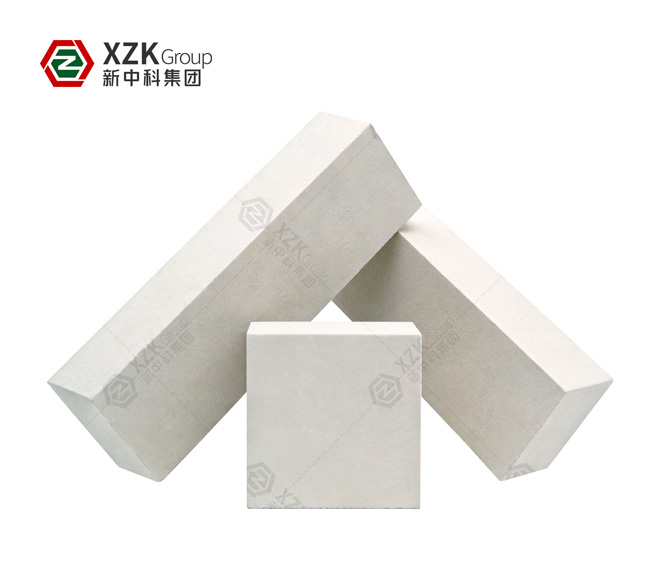
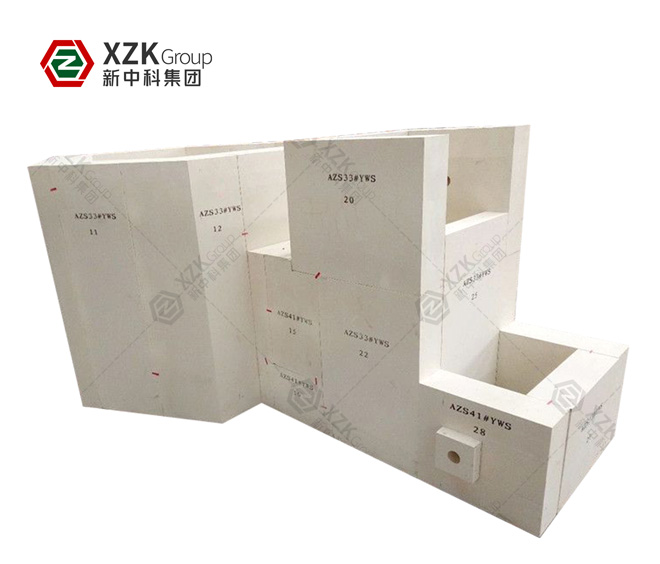
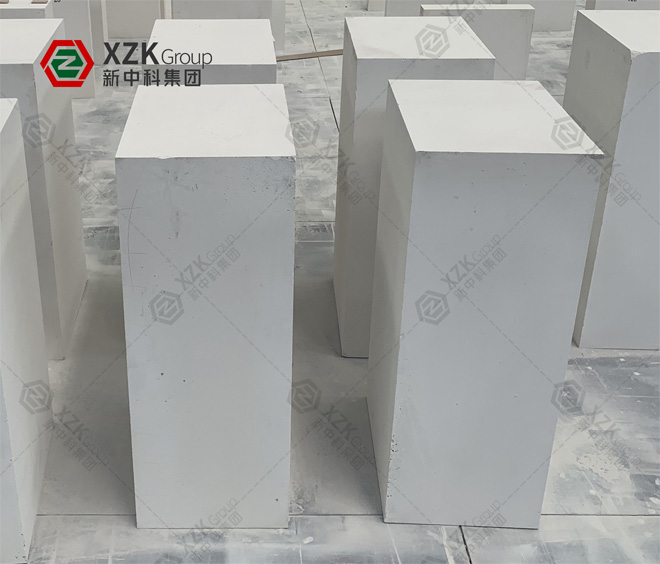
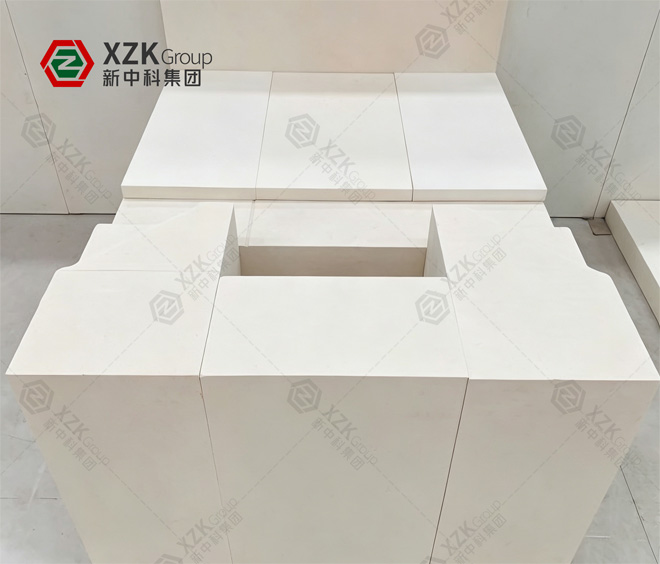
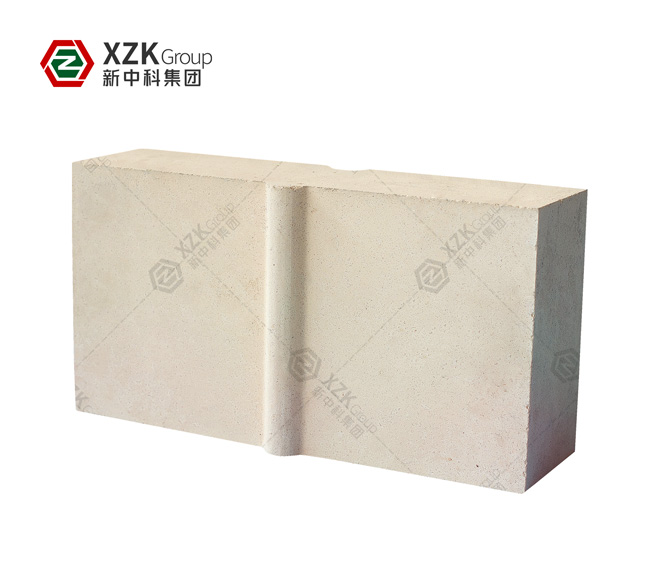
Fused cast AZS bricks are the standard glass-contact refractory for the melting tank. The material is melted in an electric arc furnace at around 2000°C and poured into moulds, so the finished block is a dense, interlocked corundum-zirconia structure with a cold crushing strength of 300 MPa or more. XZK supplies three grades — 33#, 36# and 41# — which differ in zirconia content, density and the behaviour of the glassy phase.
The three grades are not quality levels of the same product; they are engineered for different positions and different dominant wear mechanisms in the tank, and the number in each name states the nominal zirconia content.
What Is a Fused Cast AZS Brick?
The melt-and-cast route is what gives fused AZS its properties. Alumina and zirconia crystallise together as the block cools, forming an interlocked structure with a dense-part bulk density from 3.75 to 3.95 g/cm3 and a cold crushing strength of at least 300 MPa. What remains between the crystals is a small proportion of glassy phase, measured as glass phase exudation at 1500°C for 16 h and held between 2.0% and 3.0%. Casting method controls how that phase and any shrinkage cavity are distributed: the data table therefore lists density separately for the PT/QX, MS/ZWS and WS casting categories, because the same chemistry poured by different methods gives different soundness at the working face.
The grade number states the zirconia content. XZK-FAZS33 carries at least 32.5% ZrO2, FAZS36 at least 36% and FAZS41 at least 41%. Zirconia is the phase that resists dissolution by the glass melt, so corrosion resistance rises with the number, and so does dense-part bulk density, from 3.75 to 3.95 g/cm3. At the same time the silica content falls from 14.0% to 13.0% and the soda content from 1.5% to 1.3%, both of which reduce the proportion of glassy phase and its tendency to exude.
Grade selection follows the mechanism that destroys the block at a given position. FAZS33 has the highest silica and the largest glassy fraction, which gives it the best tolerance of thermal shock; it suits blocks that see repeated heating and cooling and reversal cycling. FAZS41 is the most corrosion resistant and among the least exudable, and is used where melt flow and chemical attack are most severe. FAZS36 sits between the two and is the general-purpose grade for sidewalls, paving and superstructure. Refractoriness under load is at least 1700°C (T0.5) in all three grades, so the choice is never about heat resistance — only about which attack the block will face.
Key Properties
- Three zirconia grades — 33#, 36# and 41# with minimum ZrO2 of 32.5%, 36.0% and 41.0% respectively, so corrosion resistance can be matched to the position.
- Bulk density from 3.75 to 3.95 g/cm3 in the dense part, rising with zirconia content and reported separately for the PT/QX, MS/ZWS and WS casting categories.
- Cold crushing strength ≥ 300 MPa in all three grades, giving the structural capacity required for sidewall, paving and throat blocks.
- Refractoriness under load ≥ 1700°C (T0.5) across the range, well above the service temperature of any glass contact position.
- Controlled glass phase exudation of 2.0–3.0% at 1500°C for 16 h, limiting the exudation that causes stone, cord and blowhole defects in the glass.
- Declining soda content from 1.5% in 33# to 1.3% in 41#, reducing the glassy phase that carries sodium into the melt.








 WhatsApp
 WeChat
 WhatsApp
 WeChat