

Zircon Bricks
Dense ZrSiO₄ refractories that block glass melt penetration and alkaline vapour — from 65% ZrO₂ zircon brick to the patented Three-Resistant composition.
Zircon bricks do one thing better than almost any other refractory: they stop molten glass from getting through. That single property makes them indispensable in the two places a glass furnace is most vulnerable — the tank bottom, where a leak is catastrophic, and the crown corner, where alkali vapour attacks the structure from below.
XZK Group manufactures zircon-based refractories from our Xinmi plant in Henan: dense zircon bricks in aggregate and ordinary grades, zircon mullite bricks spanning 6% to 30% ZrO2, zircon ramming mass for bottom sealing, and the patented Three-Resistant (3R) brick that combines zirconia with chromia.
Together these cover the glass-contact and alkali-resistance duties of a float, container or fibre glass furnace — including the zones where fused cast AZS alone is not the answer.
What Are Zircon Bricks?
Zircon brick is a refractory whose crystalline matrix is dominated by zirconium silicate (ZrSiO4), with a ZrO2 content of 65% or more. It is produced by high-temperature sintering from high-purity zircon sand, giving a dense body with very low apparent porosity.
Zircon’s defining behaviour in a glass furnace is that it is almost inert to molten glass. Where other refractories are progressively dissolved by the melt, zircon resists corrosion — and, critically, resists the upward drilling that destroys tank bottoms.
The properties that matter in glass contact
Zircon combines a very high melting point (2430°C) with a refractoriness under load of 1650–1680°C, so it survives in the hottest glass contact zones. Its low coefficient of thermal expansion — around 4.2 × 10⁻⁶/°C — gives excellent thermal shock resistance, which matters because bottom paving cycles as batch is charged. High density from 3.75 to 3.80 g/cm3 creates the tight, low-permeability structure that blocks melt penetration between bricks, and zircon has low wettability by glass, so the melt beads rather than spreads along the brick face.
Types and Grades of Zircon Bricks
Four families cover zircon duties in a glass furnace. They differ in how much zirconia they carry and what is combined with it — which determines whether the brick is specified for glass contact, alkali resistance or thermal cycling.

Dense zircon
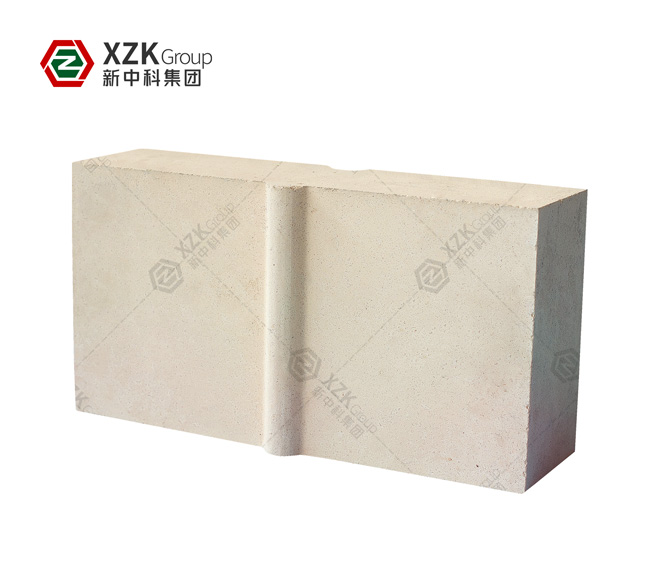
Zircon Brick
XZK-ZR65-A (Aggregate) · ZR65-B (Ordinary)
The core glass-contact material. Two grades share the same 65% ZrO2 minimum; the aggregate type runs a graded structure that lifts density to 3.80 g/cm³ and cold crushing strength to 100 MPa.
ZrO2 ≥ 65% · Density ≥ 3.75–3.80 g/cm3 · CCS ≥ 80–100 MPa
Thermal shock
Zircon Mullite Brick
XZK-ZM6 · ZM12 · ZM20 · ZM30
Zirconia combined with a mullite matrix. The mullite phase improves thermal shock resistance and volume stability, while zirconia content determines alkali resistance. Four grades span 6% to 30% ZrO2.
ZrO2 ≥ 6–30% · RUL ≥ 1680°C · CCS ≥ 80 MPa
Patented · ZL201310431067.6
Three-Resistant Brick (3R)
XZK-3R
Zirconia, chromia and corundum in one composition. The ZrO2 fraction arrests crack propagation while Cr2O3 resists alkali attack. This is the grade for positions where thermal shock, spalling and erosion occur together.
ZrO2 ≥ 7% · Cr2O3 ≥ 10% · Thermal shock ≥ 10 cycles (1100°C water-cooled)
Sealing system
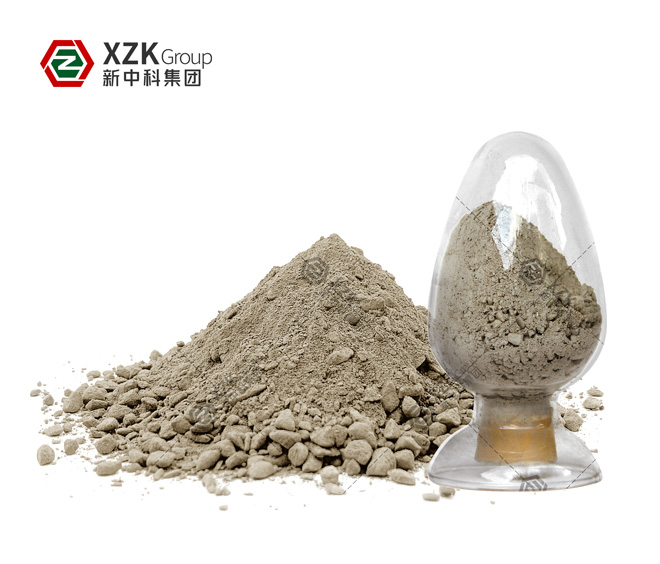
Zircon Ramming Mass
XZK-RM-ZR
A zircon-based monolithic for the sub-layer beneath bottom paving. Ramming mass fills the joints and irregular geometry that brick cannot seal, forming the second barrier against upward drilling.
ZrO2 ≥ 63% · Density ≥ 3.3 g/cm3 · CCS ≥ 50 MPa at 1200°C
Technical Specifications
Zircon performance is decided by density and porosity together — two bricks with the same ZrO2 content can behave very differently if their permeability differs. We list both.
Zircon bricks
| Property | XZK-ZR65-A (Aggregate) | XZK-ZR65-B (Ordinary) |
|---|---|---|
| ZrO2 (%) | ≥ 65 | ≥ 65 |
| SiO2 (%) | ≤ 33 | ≤ 33 |
| Fe2O3 (%) | ≤ 0.2 | ≤ 0.2 |
| Bulk density (g/cm3) | ≥ 3.80 | ≥ 3.75 |
| Apparent porosity (%) | ≤ 17 | ≤ 17 |
| Cold crushing strength (MPa) | ≥ 100 | ≥ 80 |
| Refractoriness under load (0.2 MPa, °C) | ≥ 1680 | ≥ 1650 |
Zircon mullite bricks
| Property | XZK-ZM6 | XZK-ZM12 | XZK-ZM20 | XZK-ZM30 |
|---|---|---|---|---|
| ZrO2 (%) | ≥ 6.0 | ≥ 12.0 | ≥ 20.0 | ≥ 30.0 |
| Al2O3 (%) | ≥ 65.0 | ≥ 60.0 | ≥ 58.0 | ≥ 48.0 |
| Fe2O3 (%) | ≤ 0.2 | ≤ 0.2 | ≤ 0.2 | ≤ 0.2 |
| Bulk density (g/cm3) | ≥ 2.8 | ≥ 2.9 | ≥ 3.1 | ≥ 3.3 |
| Apparent porosity (%) | ≤ 17 | ≤ 17 | ≤ 17 | ≤ 17 |
| Cold crushing strength (MPa) | ≥ 80 | ≥ 80 | ≥ 80 | ≥ 80 |
| Refractoriness under load (0.2 MPa, °C) | ≥ 1680 | ≥ 1680 | ≥ 1680 | ≥ 1680 |
Three-Resistant brick and zircon ramming mass
| Property | XZK-3R (Patented) | XZK-RM-ZR (Ramming Mass) |
|---|---|---|
| ZrO2 (%) | ≥ 7 | ≥ 63 |
| Cr2O3 (%) | ≥ 10 | — |
| Al2O3 (%) | ≥ 70 | — |
| Fe2O3 (%) | ≤ 0.3 | — |
| Bulk density (g/cm3) | ≥ 3.3 | ≥ 3.3 |
| Apparent porosity (%) | ≤ 17 | — |
| Cold crushing strength (MPa) | ≥ 100 | ≥ 50 (1200°C) |
| Refractoriness under load (0.2 MPa, °C) | ≥ 1700 | — |
| Thermal shock, 1100°C water-cooled (cycles) | ≥ 10 | — |
Test methods follow GB/T and ISO practice; ASTM equivalents and full certificates of analysis are issued with every shipment.
Where Zircon Bricks Are Used in a Glass Furnace
Zircon appears in four locations in a glass tank, each for a different reason — but all of them share one theme: stopping something from getting through.
Tank bottom paving and sub-layer
This is zircon’s most critical glass application. Heavy metal contaminants in the batch settle on the bottom paving and, if the joints are permeable, drill upward through the bottom structure — the failure mode known as upward drilling, and the one that ends a campaign with a glass leak. Zircon’s density and low wettability form an effective barrier; in most designs zircon paving works together with a zircon ramming mass sealing layer beneath it.
Typical grades: XZK-ZR65-A (paving), XZK-RM-ZR (sealing sub-layer)
Crown corner and tuck stones
The junction between the crown and the breastwall concentrates structural stress and is also where alkali vapour migrates upward from the melt. Dense zircon bricks block the alkali path that would otherwise open the joint and progressively destroy the crown springing.
Typical grades: XZK-ZR65-A, XZK-ZR65-B
Doghouse and charging ports
The charging area sees continuous thermal cycling as batch enters, plus batch dust erosion. Zircon’s low coefficient of expansion handles the cycling, and its hardness resists the abrasion that erodes softer materials in this position.
Typical grades: XZK-ZR65-B, XZK-ZM20
Forehearth and feeder channel
In the conditioning section, glass quality is everything. Zircon resists the melt without contaminating it and without exuding a glassy phase, protecting the product from stone and cord defects.
Typical grades: XZK-ZR65-A, XZK-ZM30
Burner blocks and high-cycling zones
Where thermal shock dominates and alkali attack is also present, the patented Three-Resistant brick adds zirconia to a chrome-corundum matrix. The ZrO2 fraction arrests crack propagation while Cr2O3 resists alkali — simultaneous resistance to spalling, erosion and thermal shock.
Typical grades: XZK-3R
Superstructure, alkali-dominated rear section
In the rear of a float tank, alkali evaporation attack dominates over dust erosion. Zircon mullite grades with higher ZrO2 content are specified here, bridging the gap between mullite superstructure brick and full zircon material.
Typical grades: XZK-ZM20, XZK-ZM30
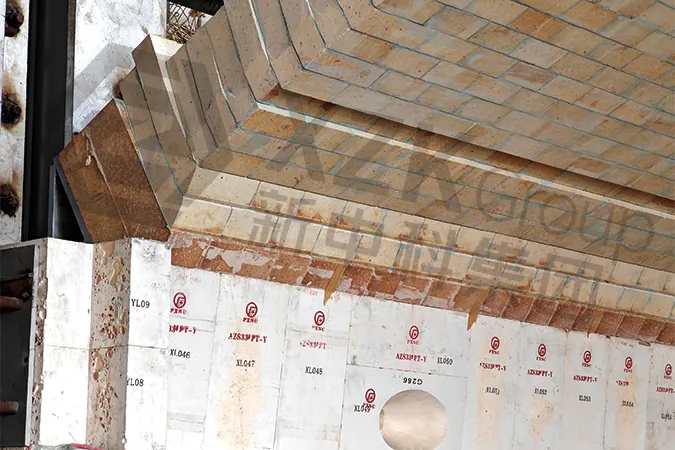
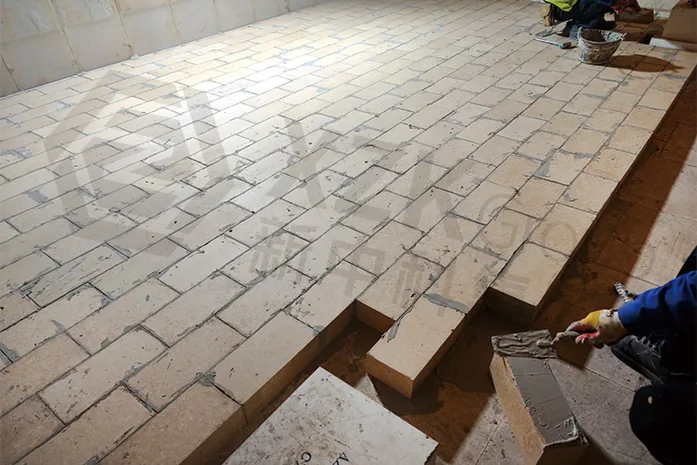
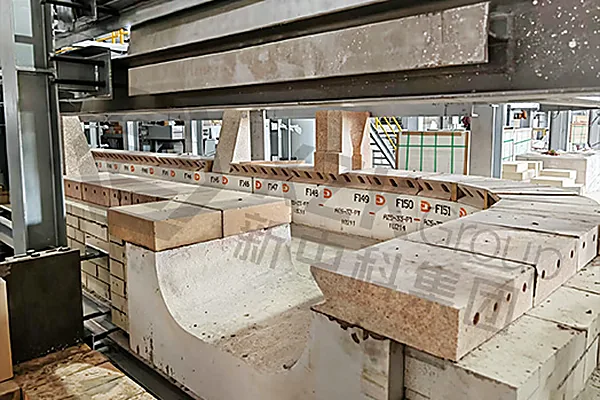
On Site — Zircon in the Superstructure and Forehearth
Zircon and zircon mullite are specified where alkali vapour does the damage — crown corners, target walls and the forehearth channel.
Failure Mechanisms and How Zircon Grades Defeat Them
Zircon is specified because of the failure modes it prevents. Understanding those mechanisms is what determines whether you need dense zircon, zircon mullite, or the 3R composition.
How to Select the Right Zircon Brick
Match zirconia content to the mechanism. More ZrO2 is not automatically better — it trades thermal shock behaviour for alkali resistance, and the right balance depends on the zone.
| If the duty is… | Dominant risk | Specify | Grade |
|---|---|---|---|
| Tank bottom paving, high pull rate | Upward drilling | Dense aggregate zircon | XZK-ZR65-A |
| Tank bottom sub-layer sealing | Melt penetration through joints | Zircon ramming mass | XZK-RM-ZR |
| Crown corner and tuck stones | Alkali vapour migration | Dense zircon | XZK-ZR65-A / ZR65-B |
| Doghouse, charging ports | Thermal cycling + abrasion | Zircon or zircon mullite | XZK-ZR65-B / ZM20 |
| Forehearth, glass quality critical | Contamination and exudation | Dense zircon | XZK-ZR65-A |
| Burner block, combined attack | Shock + spalling + erosion | Patented 3R | XZK-3R |
| Superstructure, alkali dominated | Alkali vapour attack | High-zirconia mullite | XZK-ZM20 / ZM30 |
| Superstructure, dust dominated | Dust erosion + thermal cycling | Low-zirconia mullite | XZK-ZM6 / ZM12 |
Three practical rules:
- Density decides glass contact performance. Two zircon bricks with identical ZrO2 content can have very different permeability. For bottom paving, ask for bulk density and apparent porosity figures, not just the chemistry.
- Treat the bottom as a system. Paving brick alone is not a seal. The ramming mass sub-layer closes the joints and geometry that brick cannot, and it is where upward drilling is actually stopped.
- Reserve the 3R brick for combined attack. Where only alkali is present, zircon mullite is more economical. The 3R composition earns its cost in positions where shock, spalling and erosion occur together — typically burner blocks and crown joints.
Manufacturing and Quality Control
Zircon’s performance depends on achieving consistently low porosity, which makes density control the critical process variable — a porous zircon brick is not a barrier.
Four automatic batching lines feed 20 CNC presses ranging from 630 to 2000 tonnes, so brick density is controlled by press force rather than operator judgement. Firing runs through four 108-metre fully automatic tunnel kilns and five ultra-high-temperature shuttle kilns, giving the uniform soak these materials need to complete densification.
Quality control covers the full chain: incoming raw material assay, in-process density and dimensional checks, and finished-brick testing for bulk density, apparent porosity, cold crushing strength and refractoriness under load. Every shipment leaves with a certificate of analysis.
Zircon bricks are produced from high-purity zircon sand, pressed on CNC presses of 630 to 2000 tonnes and fired in fully automatic tunnel kilns for a uniform soak. Because the temperature must be held below the point where zircon dissociates into zirconia and silica, kiln control is as important as raw material quality.
XZK Group holds ISO 9001, ISO 14001, ISO 45001 and ISO 50001 certification, is recognised as a National High-Tech Enterprise, and operates the Henan Provincial Engineering Technology Research Centre for Sintered Refractories for Glass Furnaces. We have contributed to standards including JC/T 2574-2020 (Sillimanite bricks for glass furnaces), GB/T 4984-2023 (chemical analysis methods for zirconium-containing refractories) and T/CSTM 00853-2024 (chrome-zirconia-corundum bricks for glass furnace regenerators).
Industries We Serve
Glass
Tank bottom paving and sub-layers, crown corners, doghouse, forehearths and burner zones in float, container and fibre glass furnaces.
Iron and steel
Continuous casting nozzles, ladle linings and tundish components where zircon’s thermal shock resistance and non-wetting behaviour matter.
Non-ferrous metals
Aluminium and copper contact refractories where resistance to molten metal penetration is required.
Ceramics and enamel
Specialty kiln linings and high-temperature components where the combination of refractoriness and chemical inertness is decisive.
Frequently Asked Questions
What is the difference between zircon brick and zirconia brick?
Chemistry. Zircon brick is based on zirconium silicate (ZrSiO4) with roughly 65% ZrO2 combined with silica. Zirconia brick is based on zirconium dioxide (ZrO2) at higher purity. Zircon offers a better balance of thermal shock resistance and cost; zirconia offers higher refractoriness and alkali resistance at higher cost and greater sensitivity to thermal cycling.
Why is zircon used in glass furnace tank bottoms?
Because it resists upward drilling. Heavy metal contaminants in the batch settle on the bottom and, in a permeable lining, penetrate and drill upward until the bottom is breached. Zircon’s high density and low wettability by glass make it an effective barrier — which is why it is standard in bottom paving.
What is the Three-Resistant brick and why is it patented?
The 3R brick (patent ZL201310431067.6) combines zirconia, chromia and corundum in one composition. The three phases address three failure mechanisms simultaneously — resistance to spalling, erosion and thermal shock — which conventional single-system refractories cannot do. It is specified in burner blocks and crown joints where all three occur together.
Do I need both zircon brick and zircon ramming mass?
In most bottom designs, yes. Brick provides the primary dense barrier, but joints and irregular geometry between bricks are the weak path. Ramming mass seals those gaps, forming a continuous second barrier. The two are specified as a system, not as alternatives.
Is zircon brick suitable for the crown (roof) of a glass furnace?
It is used in the crown corner and tuck stone area, not for the main crown span. The main crown is normally silica, chosen for its creep resistance at high temperature. Zircon is specified at the crown springing and similar junctions, where alkali vapour penetration and structural stress dominate.
What ZrO2 content should I specify for a superstructure application?
It depends on the balance of alkali attack and dust erosion. Higher ZrO2 content (20–30%) suits alkali-dominated positions in the rear of the tank; lower content (6–12%) suits positions where dust erosion and thermal cycling are the primary concern. Our engineers can map this against your furnace profile.
Can zircon bricks be supplied in custom shapes?
Yes. We press to drawing for bottom paving and standard shapes, and cast complex geometries such as crown corner pieces and burner surrounds. Send a drawing and we will confirm feasibility.
Why Buy Zircon Bricks from XZK Group
Zircon is where a glass furnace lining either holds or fails. We supply the complete glass-contact and alkali-resistance system — dense zircon brick, zircon mullite, ramming mass and the patented 3R brick — from our own plant, so the barrier layers are designed to work together.
Our application engineers treat the tank bottom as a system: paving, sub-layer and sealing mass specified against the same operating data. Where a zone combines multiple failure mechanisms, we specify the 3R composition rather than accepting a compromise grade.
Get your zircon specification reviewed — free
Send us your furnace data or current bottom design. Our engineers will confirm the right zirconia content for each zone, check the paving-to-sealing interface, and return a quotation within 24 hours.
Related refractory products
Zircon bricks are specified as part of a complete bottom and superstructure system, alongside dense zircon bricks, zircon mullite bricks, the patented Three-Resistant brick, zircon ramming mass, sintered AZS bricks, fused cast AZS blocks and corundum bricks. Browse all refractory products or see the zirconia series for zoning guidance.
 WhatsApp
 WeChat
 WhatsApp
 WeChat