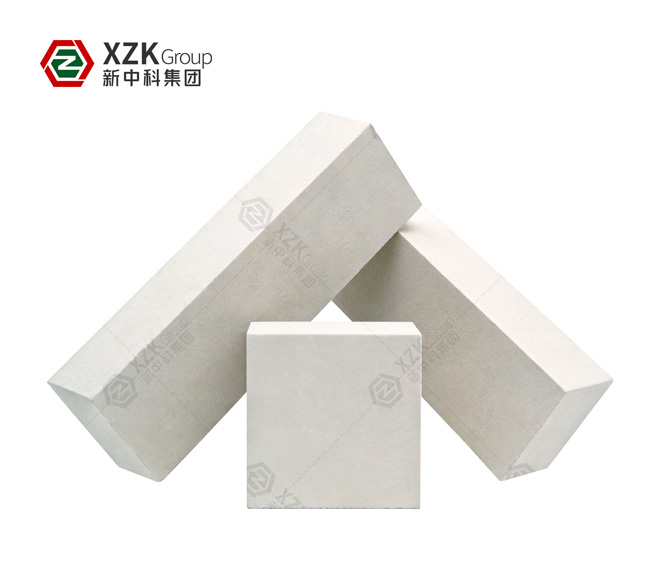
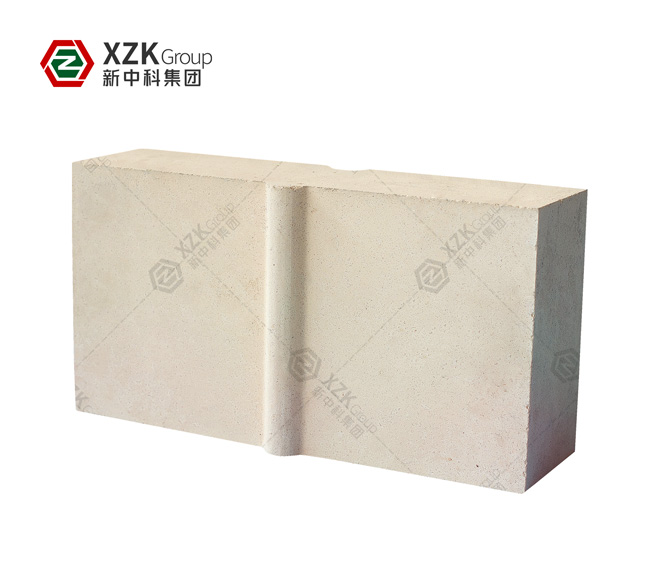
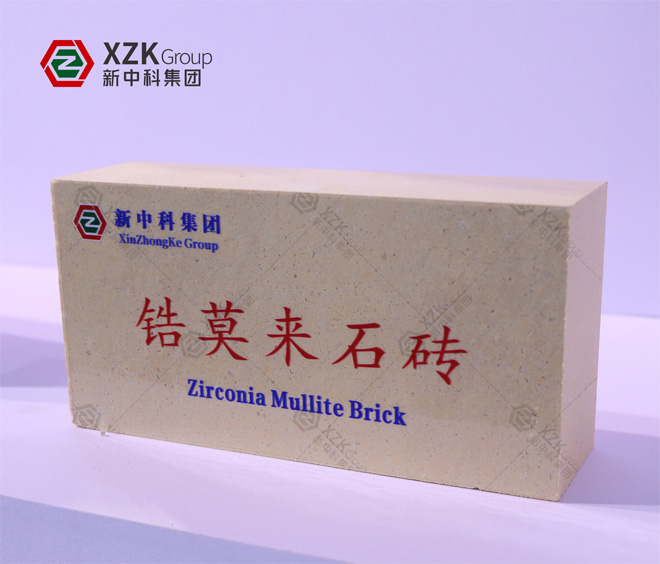
Sintered AZS bricks are alumina-zirconia-silica refractories formed by pressing and sintering rather than casting. Grade XZK-SAZS30 carries at least 48% Al2O3 and 30% ZrO2 in a mullite-bonded zirconia-corundum structure, and is specified where a dense, joint-tight refractory must contact glass without the exudable glassy phase of a fused-cast block.
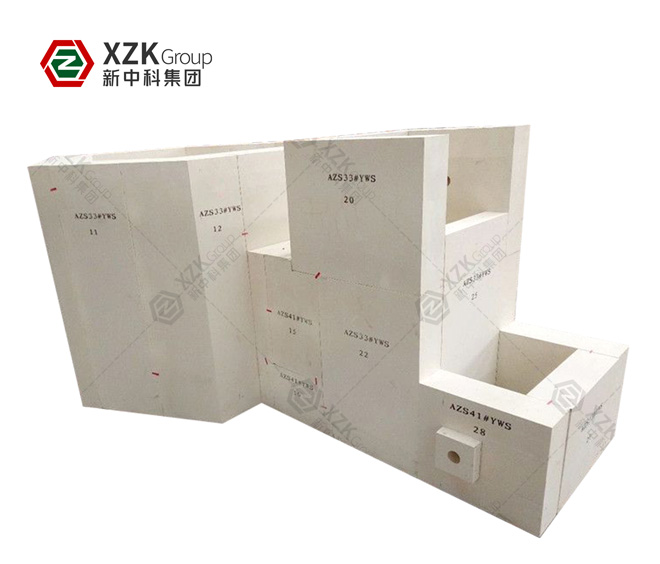
XZK Group produces XZK-SAZS30 at our Xinmi plant in Henan. In a glass furnace it appears at the doghouse, the throat, the burner port neck, the tank bottom and the superstructure, frequently as the sintered counterpart to fused cast AZS in the same lining.
What Is a Sintered AZS Brick?
The difference between sintered and fused AZS is the manufacturing route and the phase structure that results. Fused-cast AZS is melted in an arc furnace, poured into a mould and annealed; it contains a residual glassy phase and is graded by the amount of that phase and by casting method. Sintered AZS is pressed from zirconia, alumina and silica raw materials and bonded by reaction sintering, so the body is ceramic-bonded with a fine, uniform grain structure and no free glass phase able to exude into the melt.
The consequence is a brick that will not weep glassy phase into the glass bath, cannot introduce the blowholes and stones that cast material can produce, and holds a more consistent porosity across its whole cross-section than a casting whose soundness varies from the dense face to the shrinkage cavity. Iron oxide is held to 0.5% and apparent porosity to 17% or below, with a bulk density of at least 3.2 g/cm3.
Its limits are set by the same route. Cold crushing strength of at least 90 MPa and refractoriness under load of at least 1620°C are lower than a fused-cast block, so sintered AZS is chosen for positions that need thermal and chemical stability with low contamination risk rather than the maximum possible corrosion resistance. Where direct melt contact at the flux line demands the hardest material available, fused cast AZS takes that duty and sintered AZS works beside it.
Key Properties
- ZrO2 ≥ 30% and Al2O3 ≥ 48% in a mullite-bonded zirconia-corundum structure, the same chemistry family as fused AZS by a different route.
- No exudable glassy phase. The ceramic bond removes the source of glass-phase exudation, blowholes and stones that can affect glass quality at the conditioning stage.
- Bulk density ≥ 3.2 g/cm3 with apparent porosity ≤ 17%, giving the tight body needed to seal joints against melt and vapour penetration.
- Cold crushing strength ≥ 90 MPa, adequate for load-bearing courses in the bottom, doghouse and superstructure of the tank.
- Refractoriness under load ≥ 1620°C (0.2 MPa, T0.6), keeping the brick dimensionally stable in sustained high-temperature service.
- Low iron of 0.5% Fe2O3 maximum, limiting contamination of sensitive glass compositions.








 WhatsApp
 WeChat
 WhatsApp
 WeChat