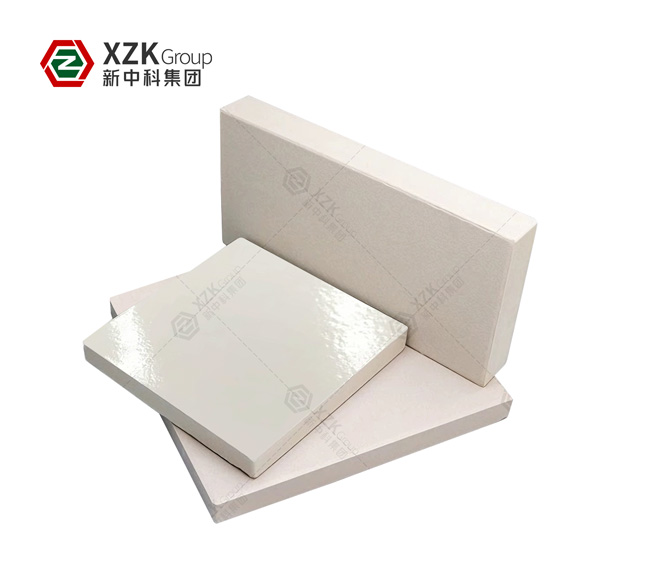
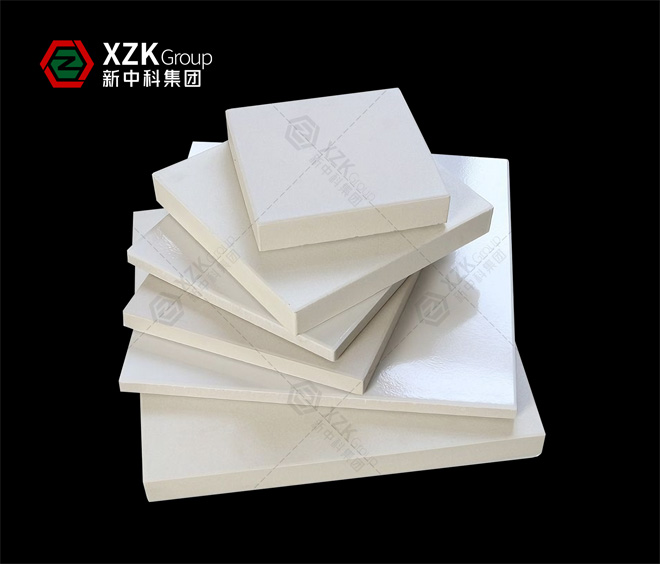
Sillimanite bricks are alumina-silica refractories built on the sillimanite group of minerals (Al2SiO5), with an Al2O3 content from 57% to 65% and a matrix that converts to mullite during firing. That mullitisation is what the glass industry buys them for: the brick keeps its shape under sustained load and tolerates the reversal cycling of a regenerative furnace.
XZK Group produces sillimanite bricks in four grades — XZK-SL57-P, XZK-SL60-P and XZK-SL65-P machine pressed, and XZK-SL60-C cast — at our Xinmi plant in Henan, and contributed to JC/T 2574-2020, the industry standard for sillimanite bricks for glass furnaces.
What Is a Sillimanite Brick?
Sillimanite, andalusite and kyanite are three polymorphs of the same mineral, Al2SiO5. Fired above roughly 1400°C, sillimanite breaks down into mullite (3Al2O3·2SiO2) and a small amount of silica-rich glass. The reaction carries a slight expansion, and manufacture is arranged so that this expansion is taken up in the kiln. The brick therefore leaves the factory dimensionally stable instead of continuing to grow in service.
Because the fired body carries a continuous mullite network with little free silica, it behaves differently from a fireclay brick. Mechanical load is carried by interlocking mullite crystals that resist sliding at temperature, so the brick has a low creep rate and a high refractoriness under load. The same matrix has a low and stable coefficient of thermal expansion, which is the origin of the material's spalling resistance.
Manufacture follows standard alumina-silica practice: graded sillimanite group aggregate and fines, automatic batching, pressing on CNC presses, drying, and firing in tunnel or shuttle kilns until mullitisation is complete. Because volume stability is the entire point of the material, the firing curve is the critical process variable, and XZK keeps it under closed-loop control rather than leaving it to the kiln operator.
Key Properties
- Refractoriness under load of 1560–1650°C at 0.2 MPa, rising with alumina content from XZK-SL57-P to XZK-SL65-P.
- Thermal shock resistance of 15–25 water-cooling cycles at 1100°C — 25 cycles for XZK-SL57-P and XZK-SL60-C, 20 for XZK-SL60-P and 15 for the denser XZK-SL65-P.
- Low, stable thermal expansion from the mullite network, which is why the brick tolerates the reversal cycling of a regenerative tank.
- Low creep under sustained load, keeping rider arches and suspended structures dimensionally true across a long campaign.
- Completed mullitisation in the kiln, so the brick does not continue to expand after it is built into the furnace.
- Bulk density of 2.40–2.50 g/cm3 and cold crushing strength of at least 70 MPa, giving a comparatively light brick with real structural capacity.








 WhatsApp
 WeChat
 WhatsApp
 WeChat