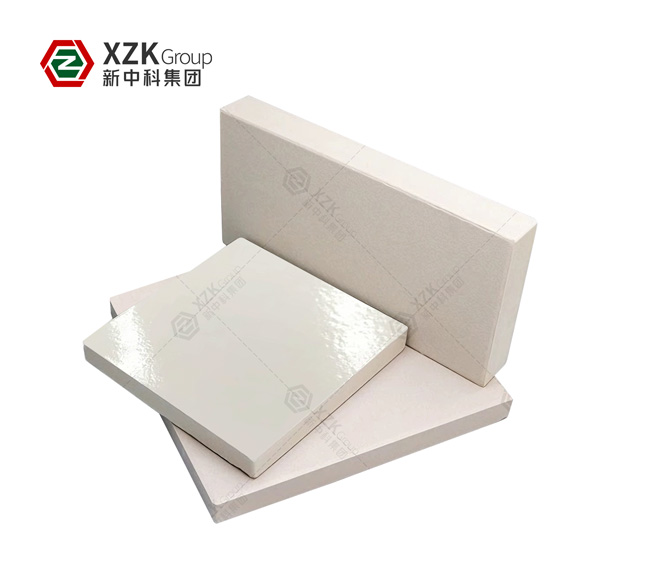
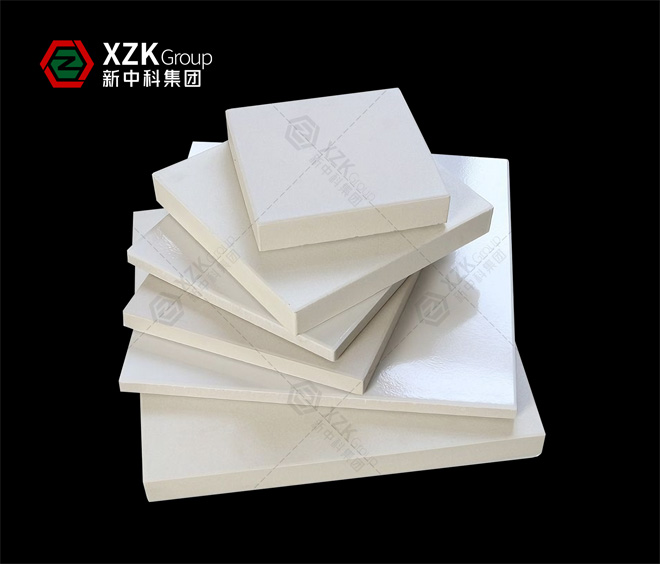
Fused silica bricks are made from amorphous fused silica with an SiO2 content of 97% or 98%. Their defining property is an extremely low coefficient of thermal expansion, a fraction of that of any crystalline silica or alumina brick, which gives them thermal shock resistance better than almost any other refractory and makes them the material of choice where a furnace zone cycles hard.
XZK Group supplies fused silica bricks in a pressed grade, XZK-FS98-P, and a cast grade, XZK-FS97-C, for the forehearth, throat and other thermally cycled, contamination-sensitive positions.
Why Fused Silica Behaves Differently
Ordinary silica brick is crystalline: it is fired to convert quartz into tridymite and cristobalite, and those phases have a relatively high and strongly temperature-dependent expansion. Fused silica is different. It is made by melting high-purity quartz and quenching it, so the material is amorphous glass, and amorphous silica has a thermal expansion coefficient of roughly 0.5 × 10⁻⁶/°C, an order of magnitude lower than a crystalline brick.
The practical effect is that a fused silica brick barely changes dimension when it is heated or cooled. That is why the material survives 30 water-cooling cycles at 1100°C without spalling, and why it can be brought up to temperature quickly without the slow, carefully controlled heating curve that a silica crown requires. The same low expansion makes the brick dimensionally stable in service.
The limitation is devitrification. Held above about 1100°C for a long period, amorphous silica slowly converts to cristobalite, and the accompanying volume change can crack the brick. Fused silica bricks are therefore used in positions that run below that threshold or that tolerate the risk, and they are not a general substitute for a silica crown. With SiO2 at 97–98% and Al2O3 held below 0.4%, they are also very low in contaminants, which matters in glass contact.
Key Properties
- SiO2 content of 97–98% with Al2O3 below 0.4%.
- Very low coefficient of thermal expansion, giving exceptional resistance to thermal shock.
- Thermal shock resistance of 30 water-cooling cycles at 1100°C, the highest of any brick in this range.
- Can be heated and cooled rapidly, unlike crystalline silica brick, which needs a controlled heating curve.
- Low bulk density of 1.86–1.90 g/cm3 and low thermal conductivity, reducing structural dead weight and heat loss.
- Refractoriness under load of 1600–1650°C at 0.2 MPa and cold crushing strength of 40–45 MPa.








 WhatsApp
 WeChat
 WhatsApp
 WeChat